Showing posts with label Wisconsin. Show all posts

Monday, July 22, 2024

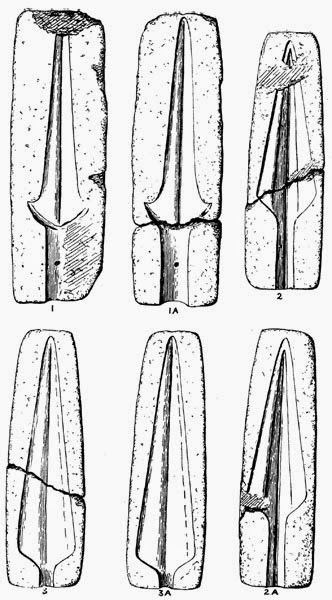
Molds For Copper (Bronze) Weapons Discovered in Wisconsin: Rewriting History


Molds For Copper (Bronze) Weapons Discovered in Wisconsin: Rewriting History


These weapons were identical to Middle Bronze Age weapons used by the giant Amorites who controlled Babylon. More here.  www.nephilimgiants.net : Biblical Amorites Weapons of the Great Lakes Copper Culture


Finds like these molds have been suppressed by archaeologists because it refutes their outdated Berengian Theory.  The lies continue...

Prehistoric America, 1899

     The Mound Builders are supposed to have been quite ignorant of any process of fusing metals, and their weapons, or implements of copperwere, as we have more than once remarked, shaped by hammering. A recent discovery, however, is claimed to modify this opinion and to prove that in one place at least the Mound Builders understood the art of smelting metals. Some recent excavations in Wisconsin have yielded not only implements of copper but the very molds in which they are supposed to have been cast. It is desirable that other facts should confirm an assertion upsetting the hitherto generally received opinion.' It has been held by some and with much probability, that the molds were used in the process of shaping cold copper, a piece of approximately similar form having been put into the mold and hammered until it took the shape of the cavity. The experiment was successfully tried by Dr. Hoy with one of the stone molds.


Get it Here

Monday, July 15, 2024

Archaeologists Refuse to Acknowledge the Dakota Sioux as the Effigy Mound Builders in Wisconsin, Minnesota and Illinois


Archaeologists Refuse to Acknowledge the Dakota Sioux as the Effigy Mound Builders in Wisconsin, Minnesota and Illinois


A Winnebago Sioux Serpent Effigy is located in Chicago, Illinois. Archaeologists are hesitant to acknowledge the Dakota Sioux as the Hopewell mound builders in Ohio and the Effigy Mound builders in Wisconsin and Minnesota for fears that they will have to surrender the thousands of artifacts and skeletal remains they have looted from their burial mounds.

"The Osage and perhaps the Omaha, who belong to the Dakota stock, and who have a tradition which is confirmed by other traditions, that they once lived east of the Mississippi in that very region, [southern Ohio].

With this understanding, it is, I repeat, a remarkable fact that, aside from the Muskogee earthworks of the gulf coast, which have distinctive characters, only the Dakotan and Iroquois stocks can be shown either by history or tradition to have been characteristic mound builders.

This legend is found amongst several of the Dakota tribes, and even amongst the later Algonquin, who returned westward to the Mississippi Valley. The Osage, Omaha, Mandan, Kansa and Akansea, and Ponca. These tribes concur in saying that they formerly dwelt in the Ohio and Wabash valleys and that they moved down the Ohio Valley, where they were separated into two divisions at the mouth of the Ohio River, some of them going down the Mississippi and some of them up the same river.

It is due to the research of the Late J. V. Brower that the Dakota tribes of Minnesota have proved to belong to the so-called mound-builder dynasty.

There is also a remarkable series of effigy mounds in central and southern Wisconsin, which extended across the Mississippi into Minnesota and Iowa. As to the prevalence of serpent worship, we have shown that there were serpent effigies in Ohio, Illinois, Minnesota, Wisconsin and Dakota, and that all these were situated along the line of migration, which according to tradition of the Dakotas, was followed by their ancestors on reaching their later seats on the Mississippi and Upper Missouri Rivers." We may conclude from this that the Winnebago was not only effigy builders, but they were serpent worshipers and that these various serpents were their work."


Wednesday, April 3, 2024

Dakota Sioux Hopewell Burial Mound Near Racine, Wisconsin Contains a Large Female


Dakota Sioux Hopewell Burial Mound Near Racine, Wisconsin Contains a Large Female


Proceeding northward from Kenosha, along the west shore of Lake Michigan, the next evidence of ancient labor are found at Racine; showing that, notwithstanding the great difference between the moral, social, political, and other conditions of the red and white man, they usually fix upon the same points as favorite places of residence. The map will convey to the reader a correct idea of the interesting groups of works at this place. In the examination of them, and in the preparation of this map, I have been materially assisted by Dr. P. R. Hoy, of Racine. The works occupy the high ground bordering upon Root River, from one to two miles from the margin of the lake, and immediately back of the city limits. They consist mostly of circular burial-mounds, of no great size or height, with one circular enclosure, and several tapering ridges. There are also two semicircles opening on the edge of the bluff towards the river. The group of very numerous and remarkable mounds represented at the lower part was surveyed with some minuteness, with a view to detecting the order of arrangement upon which they were constructed. The result shows very clearly that no order or system was adopted. Each person buried was placed where chance might lead the relatives or friends to select the spot. No three mounds could be found on the same straight line; indeed, it seems as if it were the intention of the builders to avoid all appearance of regularity. Large mounds are interspersed with smaller ones, without regard to symmetry or succession.
Dr. Hoy has recently opened one of these mounds, and found in it the skeletons of seven persons, buried in a sitting posture, and facing the east. (See Fig. 2.) The bones were not accompanied by ornaments or articles of any kind that had resisted the destructive effects of time. The teeth of the adult skeletons were much worn, but sound and firm. It was observed that the muscles of the jaws must have been unusually large and strong. The bones of the skull, except in one instance (probably that of a female), were found to be remarkably thick and solid. These skeletons were much decayed and could not be restored. The mound opened was seven feet high and fifty feet in diameter, being the largest of the group. A basin-shaped excavation had been made in the original soil, about eighteen inches deep, reaching to the gravelly subsoil, upon which the skeletons were placed side by side, all facing in the same direction. The legs, which had been laid horizontally, retained their original position; but the skulls and bones of the bodies were huddled together by the settling upon them of the earth in which they were placed. There were no indications of fire.
Another mound of smaller dimensions, opened under my inspection, contained a confused mass of bones, also very much decayed, and resting upon the gravel, which was here two feet below the original surface. Bones of at least three individuals were discovered. Their confused condition might be owing to the custom, still prevalent among the Indians, of placing the bodies of those who die or are killed away from home, in trees, where they remain until the softer parts are decayed and gone when the bones are collected and buried. No ornaments, or indeed remains of articles of any kind, could be found in this mound; nor was here any charcoal, burnt clay, or other indication of fire.
These mounds were made from the surface soil; and no traces of excavations, or places whence the materials were taken, could be detected. It is not probable that the earth was penetrated more than a few inches to obtain the quantity necessary to form the mounds, some of which are quite small, not more than one or two feet in height above the original surface of the ground. They are of various dimensions, from five to fifty feet in diameter, and from one to seven feet in height. Many of them are now nearly leveled by the plow. They may still, however, be detected in the cultivated fields by a trifling elevation, or by a slight difference in the color of the soil, In one case, at least, the plow had turned up the bones from beneath.


Saturday, February 24, 2024

Wisconsin Serpent Mound: Consort of the Earth Mother Where It Protected the Souls of the Dead.


Wisconsin Serpent Mound: Consort of the Earth Mother Where It Protected the Souls of the Dead


The Serpent Mound located on an adjacent island at Rock Lake with solar alignments to both the Winter and Summer Solstices.  Here, the Serpent has both Solar and Earth Mother connotations.

   Like all prehistoric sites where effigies and earthworks present a story. Note how all of the burial mounds are within the Serpent Mound where it acts as the consort of the Earth Mother and the protector of the dead.  For another Serpent Mound where the Serpent was acting as a protector of the dead can be sen in this never before photographed site in Ohio. www.nephilimgiants.net : Ohio's Lost, Hopewell Serpent Mound


Friday, December 1, 2023

Eastern Mediterranean Minoan Weapons Technology Found in the Upper Great Lakes Region


Eastern Mediterranean Minoan Weapons Technology Found in the Upper Great Lakes Region


One of these panels is Middle Bronze Age weapons from the Eastern Mediterranean and the other from the erroneous Copper Culture. Can you tell which is which?
Both have: Mid Rib for additional strength
Rivet Holes
Tangs                                

 Why did they raise a six-ton lobe of copper from one of the ancient mines, to make bracelets and earrings? Isn't it more likely that the copper was being mined on an industrial scale to be sent back to the Eastern Mediterranean?

About 1500 B.C. at the end of the EBA the socketed weapon was developed in the Eastern Mediterranean. This was a revolutionary discovery in military terms but also greatly increased the efficiency of farming.  An invention we still use today from shovels to brooms.  At the same time, it also appears with the Copper Culture. Quite a coincidence.  It was shortly after the development of the socket that mining operations ceased at the Isle Royal copper mines
  After 1,500 B.C. Natives in that region reverted back to the Stone Age. A more likely answer is that the Native American never made the weapons and when the people from the Eastern Mediterranean stopped mining the copper, they took their technology with them.


Friday, June 9, 2023

Sioux Indian Effigies in South Dakota, Wisconsin, and Ohio

Sioux Indian Effigies in South Dakota, Wisconsin, and Ohio


It is of interest that clear parallels exist between some of the works in Wisconsin and those found in the Ohio Valley that has been shown to have Osage origins. One of the best examples of this are the similarities between the Turtle Mound on Observatory Hill in Madison Wisconsin and the "Alligator Mound in Licking County, Ohio. The Smithsonia Bureau of Ethnology claimed that the effigy mounds in Wisconsin and Missouri werer constructed by the Sioux Indians www.nephilimgiants.net : Smithsonian Bureau Of Ethnology Claim Winnebago Sioux were the Effigy Mound Builders in Wisconsin and Ohio


                                Discover the evidence of the Sioux Indians in the Ohio Valley

Thursday, April 27, 2023

9 Foot Giant Human Skeleton Discovered in Wisconsin Mound

 9 Foot Giant Human Skeleton Discovered in Wisconsin Mound


Copper weapons were found with the giant skeleton. In this article it describes molds for these weapons disproving the fact that they were all cold hammered. www.nephilimgiants.net : Molds For Copper (Bronze) Weapons Discovered in Wisconsin: Rewriting History


The New York Times, December 20, 1897

Skeleton Found of a Man Over Nine Feet High with an Enormous Skull

      Maple Creek, Wisconsin, Dec. 19 - One of the three recently discovered mounds in this town has been opened.  In it was found the skeleton of a man of gigantic size.  The bones measured from head to foot over nine feet and were in a fair state of preservation.  The skull was as large as a half bushel measure.  Some finely tempered rods of copper and other relics were lying near the bones.   The mound from which these relics were taken is ten feet high and thirty long and varies from six to eight feet in width.  


Tuesday, February 14, 2023

Thirteen-foot Human Nephilim Giant Uncovered in Wisconsin Sold for $10,000


Thirteen-foot Human Nephilim Giant Uncovered in Wisconsin Sold for $10,000


Strange skulls of giants have been associated with the copper mines of Isle Royle www.nephilimgiants.net : Comparing Combe-Capelle (CroMagnon) Skull with a Skull Found at the Copper Mines at Isle Royale

Public Ledger (Memphis, Tennessee) August 25, 1870
WISCONSIN
 A Remarkable Skeleton Unearthed
Janesville, August 25, - Several days ago, as some laborers were digging a foundation for a barn on the grounds of Mr. Stanely, in the town of Janesville, they unearthed a human skeleton of enormous size.  It was found in a sitting posture and is in a fair state of preservation. The skull measured thirty- two and a half inch in circumference, and the thigh bones forty-four and a half inches in length.  Dr, Townsand examined the remains shortly after they were exhumed and gave it as his opinion, that when living, the man must have been not less than thirteen feet in height. It was immediately sold for $10,000. 


Wednesday, November 9, 2022

Hopewell Sioux: Rock Lake Wisconsin Solar Serpent Mound.


Hopewell Sioux: Rock Lake Wisconsin Solar Serpent Mound.


Discover the Serpent Mound swallowing an egg in Chicago, Illinois www.nephilimgiants.net : Winnebago Hopewell Sioux Indian Serpent Mound. Located in Chicago, Illinois


Solar orienttion of the Rock Lake Serpent Mound is to align with the sunrise of the Winter Solstice.  This is the day when the Sun God is reborn and was also symbolic of those spirits within the burial being born again in the after world.  One of the oldest Dakota Sioux tribes was the Winnebago who occupied Wisconsin for thousands of years and were the builders of the effigy mounds found in the State.


The Serpent Mound located on an adjacent island at Rock Lake with solar alignments to both the Winter and Summer Solstices. Note the burial mounds within the center of the Serpent Mound.

 Like all prehistoric sites where effigies and earthworks are present, a story is being told.  The serpent mound is associated with the Sun but is also the consort of the Earth Mother and the protector of the dead.  Is this the purpose of this serpent?  Was it constructed to protect those buried in the rock pyramids in the lake?
  The serpent symbol is prevalent all over this continent. It appears in effigies in Canada, Ohio, Illinois and Minnesota.  The serpent, also, is a water god, who antagonizes the chief god, and produces the great flood. The story of the flood is always associated with the serpent as the cause. The serpent, in  fact, is the source of evil.

More serpentine effigies and burial mounds were found along the shore of Rock Lake.  The fact that they are on the west side of the lake is usually associated with death, where souls go after they die, to be reborn in the east.

Friday, October 28, 2022

Two Human Giants Discovered in Gravel Pit, Near Milwaukee, Wisconsin

 Two Human Giants Discovered in Gravel Pit, Near Milwaukee, Wisconsin


More giant s discovered in Wisconsin www.nephilimgiants.net : 8 Foot European Skeleton Found at Wisconsin Earthwork

The Middletown News, Sept. 1, 1905 
    Two skeletons each measuring more than seven feet in length, were discovered in a gravel pit in Forest, near here. The skulls are as large as those of two ordinary persons and the thigh bones are almost six inches longer than those of a six-foot man. The bones are in a good state of preservation. It is probable the skeletons, which are thought to be the remains of some prehistoric race, will be sent to Milwaukee for examination.

Wednesday, October 26, 2022

8 Foot European Skeleton Found at Wisconsin Earthwork

 8 Foot European Skeleton Found at Wisconsin Earthwork


Skulls with European (Beaker People) characteristics have been found in large numbers throughout the Midwest. Evidence of these migrations can be found in "The Nephilim Chronicles: Fallen Angels in the Ohio Valley." Strange skulls that looked like "monkey heads"  at Lake Delevan , Wisconsin www.nephilimgiants.net : Stange Giant Skeletons Discovered In Wisconsin With "Monkey Heads"


History of Washington County, Wisconsin, Past and Present, 1912 
   A burial place of veritable giants was found years ago on a farm close to these strange earthworks. Some farmers were loading gravel to build a road with, when in a layer of sand they found a mass of human bones. They were struck with their size and put a skeleton together which measured eight feet from the top of the skull to the bottom of the heel bone. Alive, the owner of the bones must have been a regular giant. The skull was well preserved and in the jaws stuck teeth that measured one inch in length. It did not have the protruding cheek bones of the Indian skull and therefore pointed to a different race of men. Soon after their contact with the air, the bones were reduced to dust, which would warrant their great age; the skull alone did not crumble.

Sunday, March 1, 2020

Primitive Skulls of giant Skeletons with Double Rows of Teeth Uncovered in Wisconsin. Bigfoot?

Primitive Skulls of giant Skeletons with Double Rows of Teeth Uncovered in Wisconsin.
Bigfoot?

For pictures of these Neanderthal hybrids from Wisconsin go here Adena Hopewell Mound Builders in the Ohio Valley: Neanderthals Hybrids Discovered in Wisconsin (adenahopewellmoundbuildersohiovalley.blogspot.com)

Wisconsin Decatur Republican (Decatur Iowa) January 13, 1870
Wonderful Discovery
Skeletons of a giant race found near Potosi
From Dubuque Times, Jan. 5.
    The evidence appears to be pretty well settled that this whole western country was once inhabited by a race of beings of gigantic stature, who were not only hard-working, industrious fellows, but well up in the fine arts. What their laws, institutions, and code of morals consisted of, we shall never know, as printing presses and interviewing reporters were scarce in those days, but from the numerous mounds scattered over the country, which learned illegibletell us were the works of their hands, it is quite easy to assume that they were heavy on the dig and took much delight in wielding the spade and shovel. They would be useful fellows to have in these days of railroads and canals and its to be regretted that the race died out before the present system of internal improvements commenced.
    From time to time the skeletons of an unknown race have been discovered in the different mounds mentioned, up and down the Mississippi River, the last discovery of the kind being made near Potosi, Wisconsin, a little over a week ago. A young man by the name of Patterson, brother-in-law to S.M. Langworthy, Esq., of this city was engaged with a number of men digging out the foundation of a saw mill, near the bank of the river. In digging out this, it became necessary to remove one of these mounds or tumuli. The workman had descended to the depth of about seven feet, when they unearthed two human skeletons, the bones of which were almost entire, and in a good state of preservation upon taking them out, an accurate measurement was made of the skeletons, which one of them was found to be seven and a half feet, and the other eight feet in length. The jaws of each were filled with double rows of teeth, while the cheekbones were very high and prominent. Under the bones a large collection of arrowheads and strange toys were found, which had evidently been buried with them.
    Strange to state, the workman, instead of preserving these bones, carted them off into the road, and it feared that the great majority are now wasted. It is highly probable that other skeletons exist in the vicinity.
    Mr. Langworthy, we understand, will soon visit that locality for the purpose of preserving the skeletons already found and pushing further and more persistent search for fresh discoveries.

Monday, May 7, 2018

Strange Giant Skeletons Discovered in Wisconsin with Neanderthal Skulls

Strange Giant Skeletons Discovered in Wisconsin with Neanderthal Skulls


Strange skeletons of giants with skulls resembling those of a monkey have been discovered across North America.

New York Times, May 4, 1912
STRANGE SKELETONS FOUND
Indications That Tribe Hitherto Unknown Once Lived in Wisconsin

     Madison, Wisconsin, May 3 - The discovery of several skeletons of human beings while excavating a mound at Lake Delavan indicates that a heretofore unknown race of men once inhabited Southern Wisconsin.  Information of the discovery was brought to Madison today by Maurice Morrisey, of Delavan, who came here to attend a meeting of the Republican State Central Committee. Curator Charles E. Brown of the State Historical Museum will investigate the discoveries within a few days.

Many of these Neanderthal looking skulls were found in North America. Here is an account from California. More Neanderthal hybrids in California here 

Many of the 
New York Times, May 4, 1912 
Strange Skeletons Found
  A heretofore unknown race of men once inhabited Southern Wisconsin. The heads, presumably those of men, are much larger than the heads of any race which inhabit America today. From directly over the eye sockets, the head slopes straight back and the nasal bones protrude far above the cheek bones. The jaw bones are long and pointed, bearing a minute resemblance to the head of the monkey. The teeth in the front of the jaw are regular molars. There were also found in the mounds the skeletons, presumably of women, which had smaller heads, but were similar in facial characteristics.”

Friday, February 17, 2012

Babylonian Weapons Technology in the Great Lakes


Babylonian Weapons Technology in the Great Lakes


   Babylonian -Amorite Weapons technology in Wisconsin and Minnesota is the result of the search for copper and tin for the emerging Bronze Age. The Amorites, who were the accounted giants in the Bible had seized Babylon in 1950 B.C..  The Amorite  weapons technology and giant human skeletal remains have left a trail  of evidence from the Biblical Levant to The British Isles where they mined tin, to the northern shores of Lake Superior where they mined copper.  The mystery of the Copper Culture in the Great Lakes region is solved by comparing their weapons with those being manufactured by the Babylonians for the Hittiite, Egyptian and Hebrew armies.

   These ancient Babylonian weapons can be closely affiliated with the giant human skeletons that are found in the greatest numbers in the Levant, the British Isles and the Ohio Valley.

Friday, July 29, 2011

Evidence of Osage, Winnebago and Iroquois Traditions of Burials in Earthen Mounds


Evidence of Osage and Iroquois Traditions of Burials in Earthen Mounds


From Exerts from, Cyrus Thomas, "THE PROBLEM OF THE OHIO MOUNDS."


Early Native American burial mound in Indiana that was desecrated by university archaeologists. Universities refuse to acknowledge the overwhelming evidence that the burial mounds were constructed by early Native Americans.


     Some evidences of mound building by northern Indians may be found in the works of comparatively modern writers. Lewis C. Beck [Footnote: Gazetteer of the States of Ill. and Mo., p. 308.] affirms that "one of the largest mounds in this country has been thrown upon this stream [the Osage] within the last thirty or forty years by the Osages, near the great Osage village, in honor of one of their deceased chiefs." It is probable this is the mound referred to by Major Sibley, [Footnote: Featherstoubaugh, Excur. through Slave States, p. 70.] who says an Osage Indian informed him that a chief of his tribe having died while all the men were off on a hunt, he was buried in the usual manner, with his weapons, etc., and a small mound was raised over him. When the hunters returned this mound was enlarged at intervals, every man carrying materials, and so the work went on for a long time, and the mound, when finished, was dressed off to a conical form at the top. The old Indian further said he had been informed, and believed, that all the mounds had a similar origin.


       Lewis and Clarke mention not only the erection of a mound over a modern chief, but also numerous earthworks, including mounds, which were known to be the work of contemporaneous Indians. [Footnote: Travels, Dublin ed., 1817, pp. 30, 31, 55, 67, 115, 117, 122-125, etc.]


       L. V. Bierce [Footnote: Historical Reminiscences of Summit County, Ohio, p. 128.] states that when Nicksaw, an old Wyandotte Indian of Summit County, was killed, "the Indians buried him on the ground where he fell, and according to their custom raised a mound over him to commemorate the place and circumstances of his death. His grave is yet to be seen."


       Another writer says: "It is related by intelligent Indian traders that a custom once prevailed among certain tribes, on the burial of a chief or brave of distinction, to consider his grave as entitled to the tribute of a portion of earth from each passer-by, which the traveler sedulously carried with him on his journey. Hence the first grave formed a nucleus around which, in the accumulation of the accustomed tributes thus paid, a mound was soon formed." [Footnote: Smith's History of Wisconsin, vol. 3, 1834, p. 245.]


      According to a Winnebago tradition, mounds in certain localities in Wisconsin were built by that tribe, and others by the Sacs and Foxes.[Footnote: Wis. Hist. Soc., Rept. I, pp. 88, 89.]


There is another Indian tradition, apparently founded on fact, that the Essex mounds in Clinton County, Mich., are the burying places of those killed in a battle between the Chippewas and Pottawatomies, which occurred not many generations ago. [Footnote: Smithsonian Report, part 1, 1884, p. 848.]


         During the explorations of the Bureau in southeastern Missouri and Arkansas, finding the remains of houses in low, flat mounds was a common occurrence. Although the wood in most cases had disappeared, what had not been converted to coals and ashes having rotted away, yet the size and form, and, in part, the mode of construction, were clearly indicated. The hard-tramped, circular, earthen floor gave the size and form; the numerous fragments of burnt clay forming a layer over the floor—often taken by explorers for brick-revealed the method of plastering their dwellings; the charred remains of grass and twigs showed that it had been strengthened by this admixture; the impressions left on the inner face of these lumps of burnt plastering revealed the character of the lathing, which was in some cases branches and twigs, but in others split cane. The roof was thatched with grass or matting, the charred remains of which were found in more than one instance. In probably nine cases out of ten it was apparent these dwellings had been burned. This was found to be due to the custom of burying the dead in the floor and burning the dwelling over them, covering the remains with dirt often before the fire had ceased burning.


Alternating layers of ashes from the burning of the charnel house and cremations is the general rule of mound construction both in the Ohio Valley and in the Great Lakes region.  The early Iroquois and Sioux tribes sharing similar mortuary practices under the guise of the Hopewell Mound Builders.


      As a general rule the strata are found in this order: (1) a top layer of soil from 1 foot to 2 feet thick; (2) a layer of burnt clay from 3 to 12 inches thick (though usually varying from 4 to 8 inches) and broken into lumps, never in a uniform, unbroken layer; immediately below this (3) a thin layer of hardened muck or dark clay, though this does not always seem to be distinct. At this depth in the mounds of the eastern part of Arkansas are usually found one or more skeletons.     


     Numerous other references to the same effect might be given, but these are sufficient to show that the remains found in the mounds of the South are precisely what would result from the destruction by fire of the houses in use by the Indians when first encountered by Europeans.


     It is admitted now by all archaeologists that the ancient works of New York are attributable to Indians, chiefly to the Iroquois tribes. This necessarily carries with it the inference that works of the same type, for instance those of northern Ohio and eastern Michigan, are due to Indians. It is also admitted that the mounds and burial pits of Canada are due, at least in part, to the Hurons. [Footnote: David Boyle, Ann. Rept. Canadian Institute, 1886-1887, pp. 9-17; Ibid., 1888, p. 57.]