Showing posts with label West Virgina. Show all posts

Monday, May 20, 2024

7 1/2 - Foot Skeleton Described by the Smithsonian from a West Virginia Burial Mound


7 1/2 - Foot Skeleton Described by the Smithsonian from a West Virginia Burial Mound


Twelfth Annual Report of the Bureau of American Ethnology of the Smithsonian Institution, 1894
Kanawha County, West Virginia
      At the depth of 14 feet, a rather large human skeleton was found, which was in a partially upright position with the back against a hard clay wall. All the bones were badly decayed, except those of the left wrist, which had been preserved by two heavy copper bracelets.  Nineteen feet from the top the bottom of this debris was reached, where, in the remains of a bark coffin, a skeleton, measuring 7 1/2 feet in length and 19 inches across the shoulders was discovered. Each wrist was encircled by six heavy copper bracelets.


Get it Here

Saturday, March 4, 2023

Noted Archaeologists Measures West Virginia Skeleton at 7 feet, 2 inches.


Noted Archaeologists Measures West Virginia Skeleton at 7 feet, 2 inches.


Large skeleton measured within the Cresap Mound by Don Dragoo. Dr. Don Dragoo, who was a prominent archaeologist with the Carnegie Museum in Pittsburgh, PA.  West Virginia had many giant skeletons discovered across the state along the Ohio River and  the Kanawha River. Here is one of the largest females ever recorded.  www.nephilimgiants.net : Nephilim Queen's Tomb is Excavated at Moundsville, West Virginia.


Cresap Mound located in West Virginia is one of many burial mounds where large skeletons were entombed in their earthen graves.  


Mounds For the Dead, Dragoo, 1963
 Description of a large skeleton at the Cresap Mound

    " Measurements taken of the skeleton while still in the grave indicated an individual approximately 7.2 inches tall. In all respects the Cresap Mound skeletal material conforms to the physical type of the Kentucky and Ohio Adena.

Wednesday, November 2, 2022

100 Ancient Skeletons Discovered in A West Virginia Stone Tomb on the Ohio River

 100 Ancient Skeletons Discovered in A West Virginia Stone Tomb on the Ohio River


Bridges crossing the Ohio River at Steubenville, Ohio.  On the right bank and the West Virginia side was the location of the stone wall and mass graves within the cave. More on giant skeletons in West Virginia www.nephilimgiants.net : The Giant Adena Queen's Burial Mounds at Moundsville, West Virginia


History of the Pan Handle, West Virginia 1879

An Ancient Sepulcher

    In the summer of 1834, one Samuel Cummings, an enterprising stonemason of Stuebenville, Ohio one day crossed the river to prospect along the ledge of rocks that line the hills on the West Virginia side for a suitable place to quarry stone. In looking about he discovered a massive rock, that in some previous age of the world, had fallen from the overhanging cliffs above. While making an examination, with a view of quarrying it, he discovered an ancient stone wall built against one side of it, but almost hid from view by the accumulated rubbish of ages.  Curiosity led him to throw this wall down when an opening appeared in the rock a few feet from him, that disclosed a large cavern or vault scooped out of the underside of the rock, which, upon closer inspection, he found to contain a large number of human skeletons, packed together in perfect regularity. Visitors estimated the number at 75 to 100.

     At the time of this discovery the proprietor of the land - Colonel Nathaniel Wells - lived several miles distant, and did not hear of it for several days.  In the meantime, in the absence of anyone with authority to protect the place, visitors thronged to it by the hundreds, each one carrying away prominent portions of the remains, till they were scattered, as it were, to the winds.  Thus were the remains of the dead, of a pre-historic race, dragged from the long repose of ages and ruthlessly destroyed, to gratify the idle curiosity of the ignorant and thoughtless.

   The vault is located on the Virginia of the Ohio River, nearly opposite South Street, Steubenville, about 100 rods below Mr. Wells ferry landing, and a few east of the Pittsburgh, Wheeling, and Kentucky Railroad.

Wednesday, February 3, 2021

Smithsonian Reports Two Skeletons as "Very Large" from a South Charleston, West Virginia Burial Mound


Smithsonian Reports Two Skeletons as "Very Large" from a South Charleston, West Virginia Burial Mound

Twelfth annual report of the Bureau of Ethnology to the Secretary of the Smithsonian Institution, 1890-91
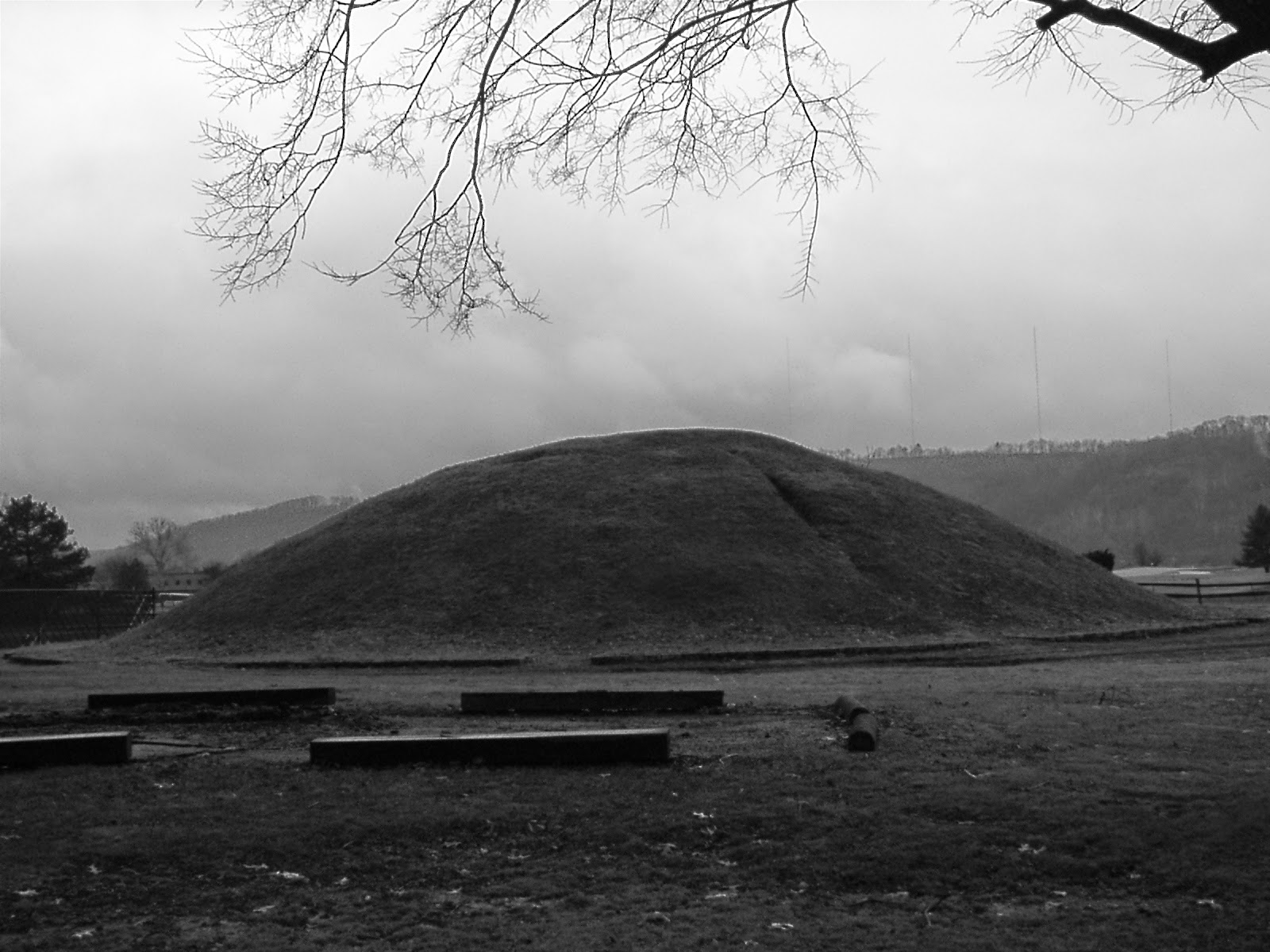


Mound 31, where two skeletons described by Smithsonian scientists as "very large" were interred facing each other. Photo from "The Nephilim Chronicles: A Travel Guide to the Ancient Ruins in the Ohio Valley, Zimmerman, 2010.   More giant skeletons in West Virginia www.nephilimgiants.net : Large Skeleton Found in Huntington West Virginia Burial Mound

Mound 31 of this group seems to furnish a connecting link between the West Virginia and the Ohio mounds. It is sharp in outline, has a steep slope, and is flattened on the top; is 318 feet in circumference at the base and about 25 feet high. It was opened by digging a shaft 10 feet in diameter from the center of the' top to the base. After passing through the top layer of surface soil, some 2 feet thick, a layer of clay and ashes 1 foot thick was encountered. Here, near the center of the shaft, were two skeletons, lying horizontally, one immediately over the other, the upper and larger one with the face down, and the lower with the face-up. There were no indications of fire about them.
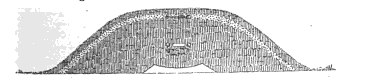


    Immediately over the heads were one celt and three lance-heads. At the depth of 13 feet and a little north of the center of the mound were two very large skeletons, in a sitting posture, with their extended legs interlocked to the knees. Their arms were extended and their hands slightly elevated, as if together holding up a sandstone mortar which was between their faces. This stone is somewhat hemispherical, about 2 feet in diameter across the top, which is hollowed in the shape of a shallow basin or mortar. It had been subjected to the action of fire until burned to a bright red. The cavity was filled with white ashes, containing small fragments of bones burned to cinders. Immediately over this, and of sufficient size to cover it, was a slab of bluish-gray limestone about 3 inches thick, which had small cup-shaped excavations on the underside. This bore no marks of fire. Near the hands of the eastern skeleton were a small hematite celt and a lance-head, and upon the left wrist of the other two copper bracelets. At the depth of 25 feet, and ou the natural surface was found what in an Ohio mound would have been designated an " altar." This was not thoroughly traced throughout, but was about 12 feet long and over 8 feet wide, of the form shown in Fig. 24.


Monday, March 17, 2014

Marion County, West Virginia Giant's Graves


Marion County, West Virginia Giant's Graves


There are numerous accounts of giant skeletons being discovered in Marion County, West Virginia


Now and Long Ago, 1969


     Near Smithtown, on lands of John C. Malone, is an Indian burying place, located under an overhanging rock, close to White Day Creek.  A  number of bones and skeletons have been taken from this ancient cemetery, by Dr. Kramer and others.

    In September, 1882, a large skeleton was unearthed in the district by F.M. Fetty and wife.  It was in a sitting position, in a rock grave, walled up with loose stones.  In the summer of 1883, James Faulkner and others found an unusually large skeleton in the district.  It is said to be that of a man whose stature was not less than seven feet, and who evidently belonged to prehistoric times. (Dr. Kramer measured the skeleton and found it to be seven-feet-four inches long, and supposed its owner, when living, must have been almost eight feet tall.


   At Rivesville once upon a time three giant skeletons were found while excavating for a new bridge, and this discovery coupled with other things nearby indicated to historians that the section was once the home of an ancient tribe of Indians.  Each of the skeletons found was more than seven feet long, and the men themselves must have been several inches taller.