Showing posts with label European skulls. Show all posts

Friday, June 11, 2021

Northern European Cro-Magnon Origins of Ohio's Mound Builders. These Two Skull Are Identical! Stop the Lies


Northern European Cro-Magnon Origins of Ohio's Mound Builders


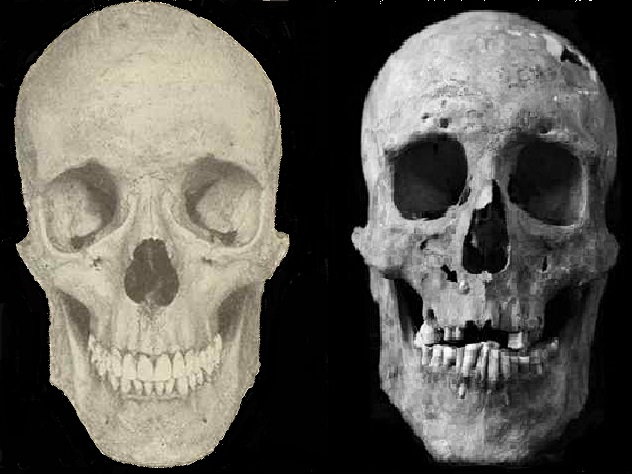
Maritime Archaic European Cro-Magnon skull is on the left with the large skull from California on the right. The domes, eye sockets, zygomatic bones, Mandibles, chins are all identical. In addition to the large size of the skull and skeleton.  The same European skulls uncovered at Mounds State Park in Indiana 

    The origin of the Maritime Archaic in North America was from Northern Europe. Marija Gimbutas, the foremost expert in European prehistory believed that the Maritime Archaic had spread to North America. My evidence certainly corroborates that conclusion. The Maritime Archaic's material culture, burial types and more importantly the skull types are identical in North America and Northern Europe. Despite archaeologists distancing themselves from using the term “CroMagnon,” the skull types associated with this Archaic type of human is the best qualifier for the description of the Maritime Archaic. The Cro-magnon skull is dolichocephalic (long), the jaw prognathous (protruding), the nose flat and the supraorbital ridges (brow ridges) pronounced.


    Northern European burials included red ochre along with other grave goods similar to what is found in North America. Dogs are found buried with children in both Northern Europe and graves associated with North America's Maritime Archaic; the purpose believed to be that the dog would protect the child in the afterlife and it had in this. More important is that the skull types are identical.


Artifacts, burial types and skeletal types eventually spread into the Ohio Valley, where they are identified with the Adena mound builders. On the left are charm stones from a burial mound in Coschocton County, Ohio.


Discover the Origins of Ohio's Mound Builders

Sunday, January 31, 2021

1800 B.C. California Nephilim Giant With a Double Row of Teeth, is Northern European!


1800 B.C. California Nephilim Giant With a Double Row of Teeth, is Northern European!


On the left is an Archaic skull from Northern Europe with the skull on the right from a burial mound in central California.  Numerous giant skeletons were reported from this region of California, some being described with a double row of teeth.   More giants with double rows if teeth

   These skull types belong to the Maritime Archaic who originated in Northern Europe and began sailing to North America as early as 7,000 B.C.  By 2,000 B.C. they had spread from the Atlantic to the Gulf of Mexico and Pacific Shores.


Free Republic, March 24, 2014
    A protruding brow, a lantern jaw, thick leg and arm bones, and teeth so crowded together that at one point they erupt in rows three deep.

Burial Types in Labrador and California Are Identical

Giant's Burial in California
  They buried their dead laying flat and face-down, rather than in a flexed position, with the heads pointing west. 
The deceased were also often sent off with a fine complement of grave goods, Bartelink said.“The mortuary assemblages are rich with projectile points, shell beads, crystal, and charmstones,
The body was daubed with red ochre on the head, chest, pelvis, left elbow, and on both hands and feet. The grave was festooned with 48 beads made from the shells of Olivella sea snails, and another 7 ornaments crafted from abalone. 

Maritime Archaic Burial in Labrador
 L’Anse Amour site in Labrador. The site was occupied from 9,000 to 2,000 years ago.
The body had been covered with red ochre
placed face down, head pointed west
Offerings included tools and weapons including charmstones


Tools of the Martime Archaic were identical in Northern Europe and North America which included slate spears, bone combs and the plummets or charm stones seen on the far right.


Monday, October 26, 2020

Ancient Giant European Skull Types Found at Mounds State Park Henge Complex in Anderson, Indiana

 Ancient Giant European Skull Types Found at Mounds State Park Henge Complex in Anderson, Indiana


Northern European Europid para-group of Cro-Magnon and Nordics, all mostly tall-statured and depigmented, and cohabitant in relative intermixture. Not primarily a phylogenetic entity.

   The appearance of long-headed skulls with an occipital bun in the Ohio burial mounds suggests that they Adena had a Nordic origin.


   While common among many of humankind's ancestors, primarily robust relatives rather than gracile, the protrusion is relatively rare in modern Homo sapiens.  A greater proportion of early modern Europeans had them, but prominent occipital buns even among Europeans are now relatively infrequent.


From Physical Anthropology Termshttp://www.theapricity.com/snpa/gloss2.htm 


NORDID (Nordic)
A group of strongly depigmented Northern European dolicho-mesocephalic ectomorphs, whose similarities are partially the result of shared origins, part of convergent evolution. There are three generally recognized Nordid types: the classic Hallstatt Nordid, the northwestern European Keltic Nordid, and the eastern European East-Nordid. For some brief speculation on the topic of Nordid origins, please read the introduction to The Nordish Gallery.


Adena skull from the Ohio Valley burial mound with an occipital bun.


Lima Daily News, (Lima Ohio) July 27, 1892

May Buy The Mounds
Congress To Purchase Prehistoric Works
(Anderson, Indiana., Letter)
Dora Biddle of Anderson a collector of antiques has a skull, and another is on the exhibition here, which has been severed just above the ears, in such a manner as to remove the crown of the head and lay the brain bare. These skulls were found with others under conditions, which would indicate that they were those of the mound builders. They are very large, show marked intellectually, and unlike skulls of the present day, or of the Indians, have a fifth skull bone in the back of the head. 


On the left is a skull from an Adena mound in Ohio. From "The Adena", Webb and Snow 1988.  On the left is a Corded Ware or Beaker People skull from northern Europe, both of which have an occipital bun.