Showing posts with label England. Show all posts

Monday, July 22, 2024

Ancient England Celtic Druid's Burial Mound Entombing a Large Skeleton is Discovered in New York State


Ancient England Celtic Druid's Burial Mound Entombing a Large Skeleton is Discovered in New York State


Burial mound is surrounded by a ditch an earthen wall, much like is found in the Ohio Valley.  This same type of burial mound was common in England with the people that constructed Stonehenge. Druid mound in New York  www.nephilimgiants.net : Celtic (Beaker People) Druid's Barrows Described in New York: Large Skeletons Discovered


History of Cattaraugus County New York 1879
    About two miles south of the village of Rutledge, in the town of Connewango, on lot No. 45, at a point about sixty rods east of Connewango Creek and near the residence of Norman E. Cowen, there was discovered by the first pioneers of this section a sepulcher mound, nearly circular in form, and having an entire circumference of 170 feet.  The height of the mound was about 12 feet.  Mr Cheney spoke of this work as "having the appearance of being constructed with the ditch outside of the mound as in Druid Barrows.
   Within the mound there were discovered 9 human skeletons, which had been buried in a sitting posture and at regular intervals of space, in the form of a circle, and facing towards a common center.  There were some slight appearances that the framework had enclosed the dead at the time of their internment.  The skeletons were so far decayed as to crumble upon exposure to the atmosphere but were all of very large size.  An osfemur (the largest found here) was 28 inches in length."


Tuesday, May 16, 2023

What is a Solar Temple, Called a Henge?


What is a Solar Temple, Called a Henge?


On the left is a henge from England and on the right a henge at Mounds State Park, in Anderson, Indiana.   The three most basic components are the Outer Earthen Wall with an Interior Ditch and a Single Gateway that many times is aligned with a Solar Event. Large skeletons are many times found within conical burial mounds within or near these sites. The henges in the Ohio Valley were constructed using the Babylonian numerological codex of Gematria   www.nephilimgiants.net : Nephilim Gematria Numerology and the Washington Monument 555 and 666

Another picture of the main henge at Mounds State Park showing the interior ditch and outer wall with the central circular platform in the middle that once held a burial mound before being destroyed by Indiana University. archaeologist.


The henge used by the ancient giant race as both a solar temple and calendar is so distinct as to preclude its development independently. The discovery of giant skeletons in the proximity of these earthworks is ample evidence that they were constructed by the same people in both the British Isles and the Ohio Valley. A henge in the British Isles is defined in Wikipedia as, “A roughly circular or oval shaped flat area over 20 meters in diameter which is enclosed by a boundary earthwork that usually comprises a ditch with an external bank and interior ditch. Access to the interior is obtained by way of one, two, or four entrances through the earthwork. Internal components may include portal settings, timber circles, post rings, stone circles, monoliths, burials, and central mounds.” It should be added that many of the gateways of the henges in the British Isles also had solar alignments.


Friday, May 12, 2023

Dinaric Nephilim Skulls In the Ohio Valley and England are Identical.


Dinaric Nephilim Skulls In the Ohio Valley and England are Identical.


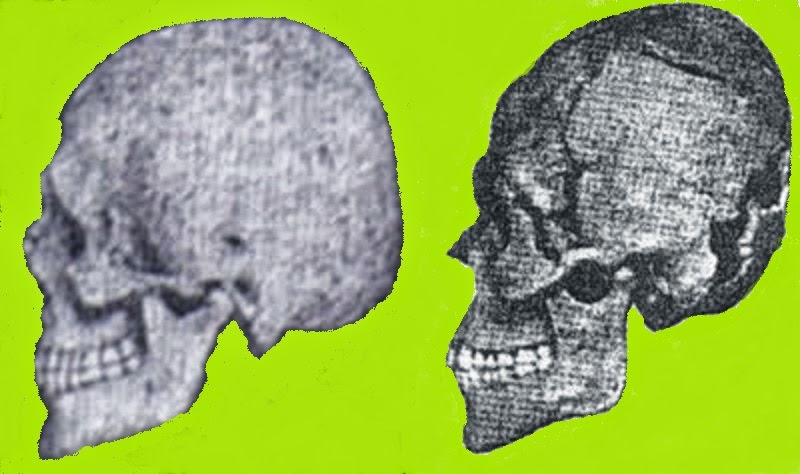
   A strange type of skull highlighted by a flattened back of the head that appears to be cut away is diagnostic of the Dinaric people.  The ancient Dinarics were one of the accounted giant tribes written of in the Bible.  


Many giant skeletons were found within the burial mounds (barrows) of England. One of these skulls is from England and the other from a burial mound in Kentucky. Can you tell the difference? www.nephilimgiants.net : Giant Skeleton Discovered in Devonshire England

The Bronze Age in Britain,
      “The Dinaric form a rare group in the world with a cranial length of 184 mm and a index over 80. This peculiarity they share with the few known Brachycephalic crania of the Upper Paleolithic. Again, reminiscent of the Upper Paleolithic skulls in the ruggedness of muscular marking, the prominence of the brow-ridge and occipital lines and the depth and breadth of the mandible.” The only other population group with this type of skull were the Adena mound builders of the Ohio Valley.
     The skulls of the Dinaric are described as being tall, short heads, a high bridge of the nose and the back of the head appearing “cut away” at the back. Facial prognathism or a jutting upper jaw is also present. On the left is a Dinaric skull from England, on the right is a Dinaric skull from Ohio
     The Dinaric spread through conquest out of the Caucasus into central Germany to Northern France. From France, the Dinarics advanced into the British Isles. Another group of seafaring Dinarics is found throughout the Mediterranean. There is evidence that the Dinarics were in the Levant at the time of the Amorites. Several of the Dinaric skulls were found in Palestine and Israel, that at first were believed to be Peruvian skulls, however, identical skulls were found and it was realized that these unique head shapes represented a different type of people. One of these skulls was found in Damascus, within the realm of the Amorites and Og.


Wednesday, May 10, 2023

Ohio Adena (Beaker People) (Amorite) Skeleton Found in an England Burial Mound

 Ohio Adena (Beaker People) (Amorite) Skeleton Found in an England Burial Mound


The Adena mound builders of the Ohio valley have the same rounded or a brachycephalic skull with prominent brow-ridges and powerful jaws as those the Beaker People of the British Isles. Some of the Adena burial in Ohio were also in stone cists.   More comparisons of Beaker People type skulls and those found in the Ohio Valley. They are an exact match! www.nephilimgiants.net : Identical England Celtic Mound Builders Skull Types Found the Ohio Valley


Giant skull from the Ohio Valley with the same unique shape as those found in the burial mounds across the British Isles associated with the Beaker People.

The Evolution Of an English Town 1922

A complete skeleton in a stone cist is now lying in a glass case in the museum. It was discovered accidentally by a farmer between Appleton-le-Moor and Spaunton. He had decided to remove a huge stone that had been an obstacle when ploughing, and in doing so found that he had removed the top stone of a cist belonging to the early Bronze Age. The man has a round or brachycephalic skull with the prominent brow-ridges and powerful jaws of the Celtic (Beaker People) people, and his right arm was arranged so that the hand was beneath the skull. By his left hand was the food vessel that is now placed on the left side of the skull, and at his feet are a number of small bronze studs or rivets.


These Bronze Age men seem to have had a very general belief in the spirit world, for the dead warrior was buried with his weapons as well as food, so that he might be sustained while he hunted in the other world with the spirit of his favorite ax or spear. The museum contains examples of socketed bronze celts and spear heads, as well as an infinite variety of arrowheads, flint knives, stone hammers and celts, and also colored beads and other ornaments.


Thursday, May 27, 2021

Dinaric Skulls Originating In the Caucasus to Germany, England, and the Ohio Valley. All Countries Where Henges are Found

 Ohio Dinaric Skulls Originating in the Caucasus to Germany, England, and the Ohio Valley. All Countries Where henges are Found


   A strange type of skull highlighted by a flattened back of the head that appears to be cut away is diagnostic of the Dinaric people.  The ancient Dinarics were one of the accounted giant tribes written of in the Bible.  


The Bronze Age in Britain,

      “The Dinaric form a rare group in the world with a cranial length of 184 mm and a index over 80. This peculiarity they share with the few known Brachycephalic crania of the Upper Palaeolithic. Again reminiscent of the Upper Palaeolithic skulls in the ruggedness of muscular marking, the prominence of the brow-ridge and occipital lines and the depth and breadth of the mandible.” The only other population group with this type of skull were the Adena mound builders of the Ohio Valley.
     The skulls of the Dinaric are described as being tall short heads, a high bridge of the nose and the back of the head appearing “cut away” at the back. Facial prognathism or a jutting upper jaw is also present. On the left is a Dinaric skull from England, on the right is a Dinaric skull from Ohio
     The Dinaric spread through conquest out of the Caucasus into central Germany to Northern France. From France, the Dinarics advanced into the British Isles. Another group of seafaring Dinarics is found throughout the Mediterranean. There is evidence that the Dinarics were in the Levant at the time of the Amorites. Several of the Dinaric skulls were found in Palestine and Israel, that at first were believed to be Peruvian skulls, however, identical skulls were found and it was realized that these unique head shapes represented a different type of people. One of these skull was found in Damascus, within the realm of the Amorites and Og.


Friday, February 12, 2021

Amorites Giants Struggle for Ascendancy of Babylon

 Amorites Giants  Struggle for Ascendancy of Babylon


    Sun worship came into prominence in its most fully developed form during the obscure period which followed the decline of the Dynasty of Isin. This was probably due to the changed political conditions which brought about the ascendancy for a time of Larsa, the seat of the Sumerian sun cult, and of Sippar, the seat of the Akkadian sun cult. Larsa was selected as the capital of the Elamite conquerors, while their rivals, the Amorites, appear to have first established their power at Sippar.
Babbar, the sun god of Sippar, whose Semitic name was Shamash, must have been credited with the early successes of the Amorites, who became domiciled under his care, and it was possibly on that account that the ruling family subsequently devoted so much attention to his worship in Merodach's city of Babylon, where a sun temple was erected, and Shamash received devout recognition as an abstract deity of righteousness and law, who reflected the ideals of well organized and firmly governed communities.
      The first Amoritic king was Sumu-abum, but little is known regarding him except that he reigned at Sippar. He was succeeded by Sumu-la-ilu, a deified monarch, who moved from Sippar to Babylon, the great wall of which he either repaired or entirely reconstructed in his fifth year. With these two monarchs began the brilliant Hammurabi, or First Dynasty of Babylonia, which endured for three centuries. Except Sumu-abum, who seems to stand alone, all its kings belonged to the same family, and son succeeded father in unbroken succession.
     Sumu-la-ilu was evidently a great general and conqueror of the type of Thothmes III of Egypt. His empire, it is believed, included the rising city states of Assyria, and extended southward as far as ancient Lagash.
        Of special interest on religious as well as political grounds was his association with Kish. That city had become the stronghold of a rival family of Amoritic kings, some of whom were powerful enough to assert their independence. They formed the Third Dynasty of Kish. The local god was Zamama, the Tammuz-like deity, who, like Nin-Girsu of Lagash, was subsequently identified with Merodach of Babylon. But prominence was also given to the moon god Nannar, to whom a temple had been erected, a fact which suggests that sun worship was not more pronounced among the Semites than the Arabians, and may not, indeed, have been of Semitic origin at all. Perhaps the lunar temple was a relic of the influential Dynasty of Ur.
     Sumu-la-ilu attacked and captured Kish, but did not slay Bunutakhtunila, its king, who became his vassal. Under the overlordship of Sumu-la-ilu, the next ruler of Kish, whose name was Immerum, gave prominence to the public worship of Shamash. Politics and religion went evidently hand in hand.
    Sumu-la-ilu strengthened the defenses of Sippar, restored the wall and temple of Cuthah, and promoted the worship of Merodach and his consort Zerpanitum at Babylon. He was undoubtedly one of the forceful personalities of his dynasty. His son, Zabium, had a short but successful reign and appears to have continued the policy of his father in consolidating the power of Babylon and securing the allegiance of subject cities. He enlarged Merodach's temple, E-sagila, restored the Kish temple of Zamama, and placed a golden image of himself in the temple of the sun god at Sippar. Apil-Sin, his son, surrounded Babylon with a new wall, erected a temple to Ishtar, and presented a throne of gold and silver to Shamash in that city, while he also strengthened Borsippa, renewed Nergal's temple at Cuthah, and dug canals.
     The next monarch was Sin-muballit, son of Apil-Sin and father of Hammurabi. He engaged himself in extending and strengthening the area controlled by Babylon by building city fortifications and improving the irrigation system. It is recorded that he honoured Shamash with the gift of a shrine and a golden altar adorned with jewels. Like Sumu-la-ilu, he was a great battle lord, and was specially concerned in challenging the supremacy of Elam in Sumeria and in the western land of the Amorites.
   For a brief period a great conqueror, named Rim-Anum, had established an empire which extended from Kish to Larsa, but little is known regarding him. Then several kings flourished at Larsa who claimed to have ruled over Ur. The first monarch with an Elamite name who became connected with Larsa was Kudur-Mabug, son of Shimti-Shilkhak, the father of Warad-Sin and Rim-Sin.
It was from one of these Elamite monarchs that Sin-muballit captured Isin, and probably the Elamites were also the leaders of the army of Ur which he had routed before that event took place. He was not successful, however, in driving the Elamites from the land, and possibly he arranged with them a treaty of peace or perhaps of alliance.
     Much controversy has been waged over the historical problems connected with this disturbed age. The records are exceedingly scanty, because the kings were not in the habit of commemorating battles which proved disastrous to them, and their fragmentary references to successes are not sufficient to indicate what permanent results accrued from their various campaigns. All we know for certain is that for a considerable period, extending perhaps over a century, a tremendous and disastrous struggle was waged at intervals, which desolated middle Babylonia. At least five great cities were destroyed by fire, as is testified by the evidence accumulated by excavators. These were Lagash, Umma, Shurruppak, Kisurra, and Adab. The ancient metropolis of Lagash, whose glory had been revived by Gudea and his kinsmen, fell soon after the rise of Larsa, and lay in ruins until the second century B.C., when, during the Seleucid Period, it was again occupied for a time. From its mound at Tello, and the buried ruins of the other cities, most of the relics of ancient Sumerian civilization have been recovered.
      It was probably during one of the intervals of this stormy period that the rival kings in Babylonia joined forces against a common enemy and invaded the Western Land. Probably there was much unrest there. Great ethnic disturbances were in progress which were changing the political complexion of Western Asia. In addition to the outpourings of Arabian peoples into Palestine and Syria, which propelled other tribes to invade Mesopotamia, northern Babylonia, and Assyria, there was also much unrest all over the wide area to north and west of Elam. Indeed, the Elamite migration into southern Babylonia may not have been unconnected with the southward drift of roving bands from Media and the Iranian plateau.
      It is believed that these migrations were primarily due to changing climatic conditions, a prolonged "Dry Cycle" having caused a shortage of herbage, with the result that pastoral peoples were compelled to go farther and farther afield in quest of "fresh woods and pastures new". Innumerable currents and cross currents were set in motion once these race movements swept towards settled districts either to flood them with human waves, or surround them like islands in the midst of tempest-lashed seas, fretting the frontiers with restless fury, and ever groping for an inlet through which to flow with irresistible force.
    
     Northern Babylonia and Assyria probably attracted the tillers of the soil. But the movements of seafarers must have followed a different route. It is possible that about this time the Phoenicians began to migrate towards the "Upper Sea". According to their own traditions, their racial cradle was on the northern shore of the Persian Gulf. So far as we know, they first made their appearance on the Mediterranean coast about 2000 B.C., where they subsequently entered into the competition as sea traders with the mariners of ancient Crete. Apparently, the pastoral nomads pressed northward through Mesopotamia and towards Canaan. As much is suggested by the Biblical narrative which deals with the wanderings of Terah, Abraham, and Lot. Taking with them their "flocks and herds and tents", and accompanied by wives, and families, and servants, they migrated, it is stated, from the Sumerian city of Ur northwards to Haran "and dwelt there". After Terah's death, the tribe wandered through Canaan and kept moving southward, unable, it would seem, to settle permanently in any particular district. At length "there was a famine in the land"--an interesting reference to the "Dry Cycle"--and the wanderers found it necessary to take refuge for a time in Egypt. There they appear to have prospered. Indeed, so greatly did their flocks and herds increase that when they returned to Canaan they found that "the land was not able to bear them", although the conditions had improved somewhat during the interval. "There was", as a result, "strife between the herdmen of Abram's cattle and the herdmen of Lot's cattle."

The Complete History of the Nephilim Amorite

Monday, February 1, 2021

Ohio Giant's Skull Type Found in an England Burial Mound

 Ohio Giant Skull Type Found in an England Burial Mound


The Adena mound builders of the Ohio Valley have the same rounded or brachycephalic skull with prominent brow-ridges and powerful jaws as those the Beaker People of the British Isles. Some of the Adena burial in Ohio were also in stone cists.


Giant skull from the Ohio Valley with the same unique shape as those found in the burial mounds across the British Isles associated with the Beaker People.


The Evolution Of An English Town 1922

A complete skeleton in a stone cist is now lying in a glass case in the museum. It was discovered accidentally by a farmer between Appleton-le-Moor and Spaunton. He had decided to remove a huge stone that had been an obstacle when plowing, and in doing so found that he had removed the top stone of a cist belonging to the early Bronze Age. The man has a round or brachycephalic skull with the prominent brow-ridges and powerful jaws of the Celtic (Beaker People) people, and his right arm was arranged so that the hand was beneath the skull. By his left hand was the food vessel that is now placed on the left side of the skull, and at his feet are a number of small bronze studs or rivets.
These Bronze Age men seem to have had a very general belief in the spirit world, for the dead warrior was buried with his weapons as well as food so that he might be sustained while he hunted in the other world with the spirit of his favorite ax or spear. The museum contains examples of socketed bronze celts and spearheads, as well as an infinite variety of arrowheads, flint knives, stone hammers and celts, and also colored beads and other ornaments.
    

Thursday, October 15, 2020

Biblical Giants (Anak) Come to England to Mine Tin For the Bronze Age

 Biblical Giants (Anak)  Come to England to Mine Tin For the Bronze Age


   In “L’Anthropologie, 1921
    M. Siret found that the prehistoric Stone Age settlers in S. Spain were civilized sea-going traders from “Syria,” seeking ores, and they traded in manufactured"
     Regarding the tradition that “giants” occupied Britain before Brutus, and that “giants” were the builders of the stone circles and megaliths and “giants” tombs in Brittany, Mauretania, Sardinia, and in other places colonized by the Phoenicians, it is significant that the Mor, Muru, Maruti or “Amorites of Syria-Phoenicia-Palestine are called “giants” by the Hebrews in their Old Testament. They are, moreover, called there “the sons of Anak” (Beni-Anak) Now “Anak” in Akkadian is a name for “Tin” And Tarnish, which, as Tarz or Tarsus, we have seen was a chief port of the Amorite Phoenicians, and which we know was actually visited and conquered by Sargon I., is thus celebrated in the Old Testament in connection with Tyre of the Phoenicians: “Tarnish was thy merchant by reason of the multitude of all kinds of riches; with silver, iron Tin, and lead, they traded their fairs” Ezek 27:12
    Between the Persian Gulf and the Red Sea, in the district of Kasinare reported three huge rude stone circles, which are described as being “like Stonehenge” and, like it, composed of gigantic trilithons about 15 ft. high; and several huge Stone Circles in the neighborhood of Mt. Sinai, some of them measuring 100 ft. in diameter.
     On the N.W. frontier of India, on the route from Persia near Peshwar, is a large circle of unhewn megaliths about 11 ft. high and resembling the great Keswick Circle in Cumberland
And amongst the many megaliths along the Mediterranean coast of Africa, so frequently by the Phoenician are several Stone Circles in Tripoli and Gaet-uli hill with trilithon, like Stonehenge

Wednesday, April 15, 2020

Did a Giant Race Build Stonehenge? Here's the Evidence

Did a Giant Race Build Stonehenge? Here's the Evidence


Another henge is found in Germany that is identical to those in England and the Ohio Valley. For photos of these henges in Germany and the Ohio Valley that are identical www.nephilimgiants.net : Ancient Henge (Sun Temple) Discovered in Germany with Links to the Ohio Valley


Our Early Ancestors, an Introductory Study of Mesolithic, Neolithic and Copper Age Cultures in Europe and Adjacent Regions, by M.C. Burkett, M.A., F.S.A., F.G. 1876
The invaders differed somewhat from the former inhabitants of the land. The Neolithic folk seem to have been of moderate stature, long-headed, oval faced, narrow nosed, with small features. They were not at all powerfully built race. The new-comers on the other hand- according to Abercromby- were characterized by a short square skull showing a great development of the superciliary ridges and eyebrows. The cheekbones, nose, and chin were prominent, and the powerful lower jaw was supplied with large teeth. They were a tall, strongly built race and must have presented- at any rate as far as men were concerned- a fierce, brutal appearance.  The dead were buried in round barrows, inhumation being practiced. They knew about the use of copper and introduced into England the beaker type pot.
Skeletons along with these characteristics are diagnostic of the Upper Paleolithic Cro Magnon.  This same type of Archaic skull is found in the burial mound Giant skeletons with "primitive" skulls with a protruding brow ridge and other archaic characteristics have been found in the burial mounds around Stonehenge.  The large size of the primitive nature of the skulls is the same in the Ohio Valley mounds.

Remains of the Prehistoric Age in England, 1888
   Here again, there is no lack of skulls and skeletons, and the descriptions of them are many. In the barrows of this period, we find two classes of skulls, long and broad. The former may be those of the earlier people, the latter those of a race that had invaded the country. Or the collocation may be explained without supposing the arrival of a different race, but these are points into which it is impossible to enter here. Suffice it to say that the skulls regarded as typical of this period are brachycephalic, of large size and with well-formed brow. There are salient ridges above the eyes, but these are not the monstrous projections of the Neanderthal type. One gains the idea that the cast of the countenance of the possessors of these skulls must have been much more fierce and commanding than that of the milder race which preceded them.


Historical, Topographical, and Descriptive View of the County of Northumberland 1825

       The ancient Britons were remarkable for the large statue of their bodies; their eyes were generally blue, which was esteemed a great beauty; and their hair red or yellow, though in many various gradations. They were remarkably swift of foot and excelled in running, swimming, wrestling, climbing, and all kinds of exercises in which either strength or agility was required. Accustomed to hardships and despising cold and hunger, in retreating they plunged into the morasses up to the neck, where they remained several days. They painted their bodies with a blue dye extracted from woad, and at an early age they were tattooed in a manner the most ingenious and hideous; and in order to exhibit these frightful ornaments in the eyes of their enemies, they threw off their clothes in the day of battle. When advancing to the combat their looks were fierce and appalling, and their shouts loud, horrid, and frightful.

Monday, July 23, 2018

Two Nephilim Skeletons Unearthed in England

Two Nephilim Skeletons Unearthed in England


Charleston Daily Mail, April 23, 1925
—Two giant human skeletons recently were unearthed in a sand quarry in England.