Showing posts with label skulls. Show all posts

Friday, August 2, 2024

Randolph County's Largest Ancient Adena Mound

 Randolph County Indiana's Largest Ancient Adena Mounds
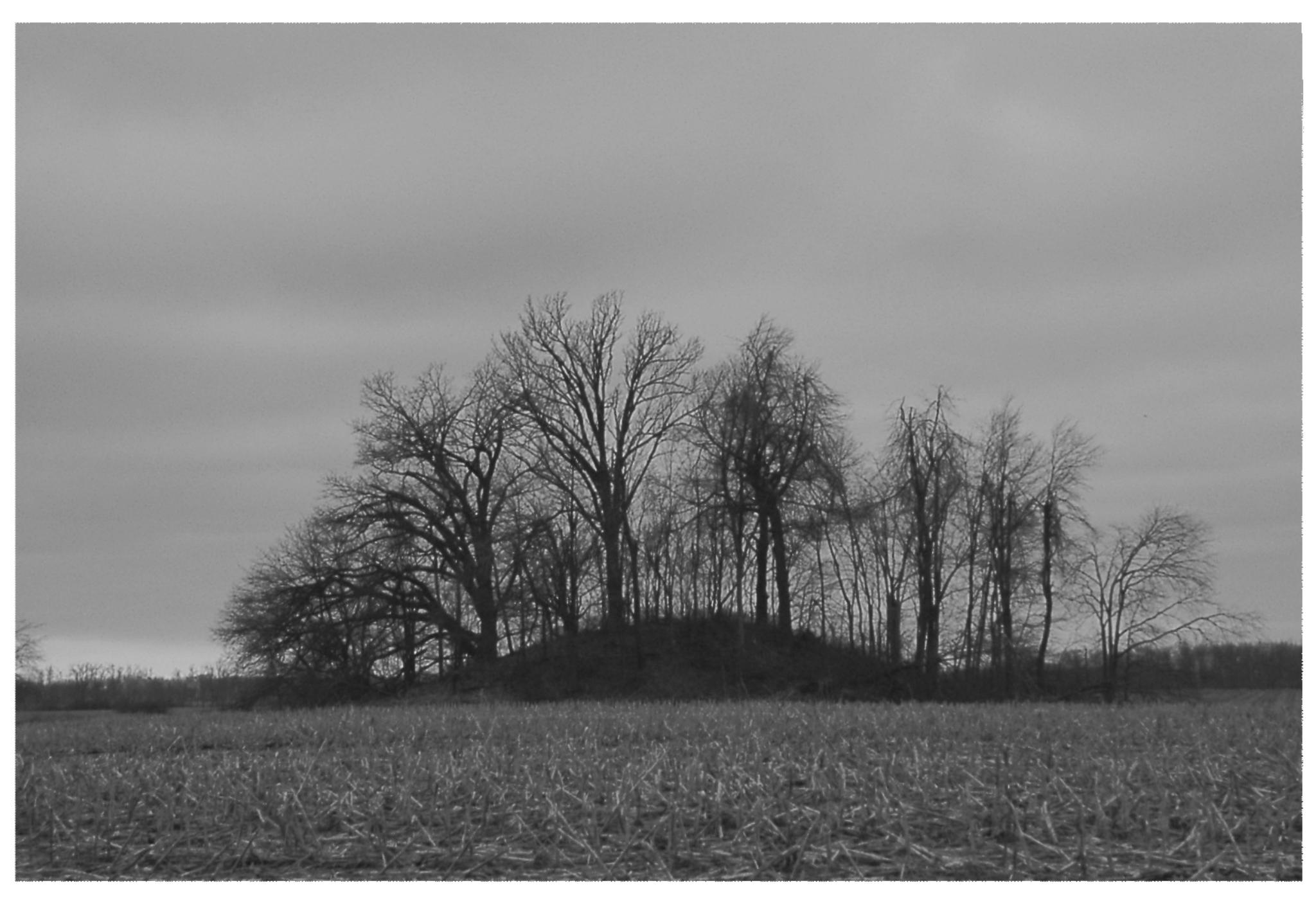
This Adena burial mound is one of three of these large mounds that once were within a mile of one another. To the north of this mound is the small town of Snow Hill whose namesake is from a now destroyed mound. 


Concerning a Burial Mound Recently Opened in Randolph County” by Joseph Moore

From Proceeding of the Indiana Academy of Science, 1894

    Besides a number of well-defined made mounds in the neighborhood of Lynn Station on the G.R. & I. R.R. there are frequent examples of natural mounds. These are usually much larger than the artificial mounds. They may be compared to drift islands surrounded by flat areas of dark colored soil. Ancient peoples as burial grounds have utilized some of these mounds of modified drift. The one of which I speak is a fraction over a mile west of Lynn Station. It is about 150 years in circumference and eighteen to twenty feet high and is so symmetrical as to have the appearance of a made mound; but in a wide cutting made through it by the gravel haulers the structure clearly shows an aqueous deposit from top to bottom. In this mound the workmen say they have opened “more than a hundred graves.” They “counted till they reached seventy.” Quite a number of the skulls were sufficiently preserved to bear handling, even after being for a short time exposed to the air. Some of them on being treated with a solution of glue have rather a fresh, recent look. Very many of the bones were broken to crumbs by visitors in sport. Some of the skeletons were in a sitting posture with the chin crowded upon the knees.

The depth of the graves was from a yard or less to twelve feet and more. The skeletons were of both sexes and various ages, some quite young. It was alleged that a horse’s bones were found, but I was unable to find the least scrap. They also tell of a dog’s skull with the teeth all perfect. This is possibly so, but it would seem more likely that it was the head of a wolf, which is quite similar. Quite a number of implements were found some of which are here on the table. One skeleton was found with a large dart in each hand.

They assert that a scapula was found pierced by a flint dart and that the dart was lodged in said bone, but that the bone immediately crumbled from about it. There were beads of bone, shell and copper (but few of the latter) copper rings, tube pipes and various other things, the uses of which are not very well known.

You will see in the skulls presented for your examination that there is quite diversity. Two of them are of the brachycephalic or short-head type, one barely so, the other extremely so. The one has the lateral diameter in the proportion to the fore and aft, as 86 to 100, the other 92 to 100. The others are all orthocephalic, though one of them approaches to the longhead type.

You will note not only the extent to which the teeth are worn, but also the peculiar manner of the wearing. It will also be seen that decayed teeth, caries of the bone and also signs of gumboils and abscesses are not confined entirely to civilized races.

The upper wisdom teeth in one of the skulls show, each, examples of enamel tubercles on the fangs, a rather rate phenomenon, as I understand.

You will note also in one of them an extraordinary double suture at upper border of occiputA question of interest: Did such diverse skulls belong to the same tribe, or did different tribes at different times bury in the same grounds?


Monday, July 22, 2024

Primitive Skulls of the Nephilm Giant Skeletons Described in England

 Primitive Skulls of the Nephilm Giant Skeletons Described in England


Our Early Ancestors, an Introductory Study of Mesolithic, Neolithic and Copper Age Cultures in    Europe and Adjacent Regions, by M.C. Burkett, M.A., F.S.A., F.G. 1876


The invaders differed somewhat from the former inhabitants of the land. The Neolithic folk seem to have been of moderate stature, long-headed, oval faced, narrow nosed, with small features. They were not at all powerfully built race. The newcomers on the other hand- according to Abercromby- were characterized by short square skull showing a great development of the superciliary ridges and eyebrows. The cheek-bones, nose and chin were prominent and the powerful lower jaw was supplied with large teeth. They were a tall, strongly built race and must have presented- at any rate as far as men were concerned- a fierce, brutal appearance. The dead were buried in round barrows, inhumation being practiced. They knew about the use of copper and introduced into England the beaker type pot.

Remains of the Prehistoric Age in England, 1904

Here again there is no lack of skulls and skeletons, and the descriptions of them are many. In the barrows of this period, we find two classes of skulls, long and broad. The former may be those of the earlier people, the latter those of a race which had invaded the country. Or the collection may be explained without supposing the arrival of a different race, but these are points into which it is impossible to enter here. Suffice it to say that the skulls regarded as typical of this period are brachycephalic, of large size and with well-formed brow. There are salient ridges above the eyes, but these are not the monsterous projections of the Neanderthal type. One gains the idea that the cast of the countenance of the possessors of these skulls must have been much more fierce and commanding than that of the milder race which preceded them


Saturday, January 7, 2023

Were the Ohio Mound Builders the Last Remnants of the Cro-Magnons?


Were the Ohio Mound Builders the Last Remnants of the Cro-Magnons?


There is little difference between the Cro-Magnon and the Ohio mound builder's skull types. Most of the skulls of the mound builders in Ohio were described as having a furrowed brow that is reminiscent of the Cro-Magnon.  This same skull type is also found within the English barrows belonging to the Beaker People.  What the Ohio mound builders skulls don't look like are any of the historic Indians from the Ohio Valley.

Wednesday, October 26, 2022

Primitive Neanderthal Hybrids of the Maritime Archaic


Primitive Neanderthal Hybrids of the Maritime Archaic


Signature skull type of the Maritime Archaic is a long skull with a sloping forehead and protruding brow ridge.  On the left is the Penon woman dating to 11,000 B.C. In the Middle are similar skull from a shell mound in Alabama and on the right is a skull from the Santa Barbara, California mound.
All of these skulls are more indicative of Upper Paleolithic proto-Europeans than of Mongolian or Native Americans. More of these type skulls were found near the Alabama skulls and diagrammed. www.nephilimgiants.net : Louisiana Historical Society Reports: Large Neanderthal Looking Skulls with Double Rows of Teeth

Thursday, October 20, 2022

Louisiana Historical Society Reports: Large Neanderthal Looking Skulls with Double Rows of Teeth


Louisiana Historical Society Reports: Large Neanderthal Looking Skulls With Double Rows of Teeth 


  Recreation of the skull removed from the Latro Mounds published in the Louisiana Historical Society Publication For a good picture of what one of these skulls looked like www.nephilimgiants.net : Mass Grave of Giant Nephilim Hybrids Discovered in Malibu Beach, California


Publications Louisiana Historical Society Vol., I, 1901

The Mounds of Lousiana by Prof. George Beyer

The Larto Group

  On the morning of my arrival at Fair Play Landing, I found quite a number of gentlemen ready to accompany me to the mounds. These were nearly ten miles distant and situated on the banks of a horseshoe-shaped Lake Larto. The road led for some distance along Black River, then out across the country to the head of the lake, but ended shortly after passing the mounds.

   In the preceding pages I have somewhat transgressed, and I must now take up my report in regard to the location and formation of the group of mounds, which has given us, not only so much material for reflection and speculation, but has brought us face to face with the facts of the aborigines of Louisiana, of which we knew but little heretofore. I found the group consisting of four mounds, situated immediately on the banks of the lake. Three of them are of about the same size, while the fourth is smaller by one-half-in every respect, with the exception of the height-which about equals that of the others, at least at the present time. The diameter of the larger mound at the base ranges from 150 and 160 feet. The height of all of them is now only between seven and eight feet. Their original height has been probably twice that much, but continued use by men and cattle have tended not only to compress the earth but has also caused the wearing away of considerable of its material. The mounds are about 100 feet apart and are connected by ridges, which to some extent still remain. These ridges were, I suppose, from ten to fifteen feet wide at their base, but only about three or feet high. Mounds and connecting ridges were well covered with vegetation; on nearly, all fairly large trees were growing. On one of the mounds a planter had built his residence and on another his corn crib; and during overflows, that gentleman informed me, both remained high and dry. While the first larger one, coming from the direction of the Black River.

The bones were lying close together, and the bodies had been buried side by side-head toward the south, feet to the north. It was practically impossible to obtain an entire skull or skeleton, and every single bone had to be cut out of the hard clay with the knife. On the left side of some of the skulls, I found the fragments of vases or bowls, also a few arrowheads, and with one of the bodies, a medium-sized ax had been buried.

    After the removal of the remains, I continued the excavation, and suddenly I came upon a bed of ashes. This bed covered a small area of about four feet square and was about an inch and a half in thickness. Examination of the ashes revealed charred catfish ribs and garfish scales, but to say whether these were the remains of sacrificial rites or of a repast would be assuming to much...While yet removing some traces of the ash bed I came upon another skeleton, and proceeding with the greatest caution I discovered two others lying close to it

In regard to their physical standard it is well conceded that the 


One of the skulls removed from the Latro mounds was noted for its thickness and the occipital bun that is diagnositic of Archaic type skulls. More Neanderthal hybrids found here Mysteries of Ancient America Books: Smithsonian Anthropologists Call Giant Skulls from the Burton Mound in Santa Barbara, California


   Quite a sensation was created by the fact that part of the skull (frontal bone) was found which measured actually 7/8 of an inch in thickness. Upon further search, I found other portions of the same skull of corresponding thickness. This, however, proved to be only an exceptional case, for the majority of the other skulls present no such abnormal development; but upon comparing them in this respect with so-called mound builders' skulls from other sections, an excessive thickness is noticeable. In the same line of abnormality was the finding of one of one skull in which the dentition reached the unusual number of forty teeth, the increase consisting of eight additional incisors. The remarkable preservation of the teeth is noteworthy.


   This was not an isolated case, many large skeletons were described with double rows of teeth.  Here is one from New York  

Monday, October 17, 2022

8 Ancient Giants with Primitive Skulls Buried Like a Sun Wheel in Walkerton, Indiana Mound


8 Ancient Giants with Primitive Skulls Buried Like a Sun Wheel in Walkerton, Indiana Mound


Archaic type skull with a protruding brow ridge and sloping forehead. This type of skull is diagnostic of the Maritime Archaic who spread into the Great Lakes region. 


The News, October 23, 1925
MOUND GIANTS IN INDIANA SAID TO ANTEDATE INDIAN
   South bend, Indiana - Eight skeletons, one of them clad in copper armor, and a heard of rare war weapons and bits of personal adornment have been found in a mysterious mound on the farm of Grove Vosburg near Walkerton.
Vosburg, a 70-year-old farmer, had long desired to know the secret of the mount, which, according to local tradition dates back thousands of years. Secretly excavating the pile of earth he came upon a strange burial place.
Giant Skeletons
    The eight skeletons lay in a circular formation, arranged like the spokes of a wheel, with skulls together.  Copper breastplates, bands and other bits of armor adorned the skeleton on one man, who apparently had been of giant stature.  Embedded in this skull was a beautifully chipped arrowhead.
The soft earth of the mound revealed other treasures. Three pounds of ore believed to be either silver or white gold, lie with the bones. There were corroded copper bands, which antiquarians here believe were used to bind war clubs, two pipe bowls, one of smooth black stone and the other carved replica of a fantastic monster, were found.
   The belief that the bones are not those of Indians, but belonged to the ancient and little-known race of mound builders has arisen because of the great size of the bones and the fact that the skull formations are not those of the Indian types.  The skulls seem to have little forehead and the eye cavities are high in the head

Monday, February 1, 2021

Ohio Giant's Skull Type Found in an England Burial Mound

 Ohio Giant Skull Type Found in an England Burial Mound


The Adena mound builders of the Ohio Valley have the same rounded or brachycephalic skull with prominent brow-ridges and powerful jaws as those the Beaker People of the British Isles. Some of the Adena burial in Ohio were also in stone cists.


Giant skull from the Ohio Valley with the same unique shape as those found in the burial mounds across the British Isles associated with the Beaker People.


The Evolution Of An English Town 1922

A complete skeleton in a stone cist is now lying in a glass case in the museum. It was discovered accidentally by a farmer between Appleton-le-Moor and Spaunton. He had decided to remove a huge stone that had been an obstacle when plowing, and in doing so found that he had removed the top stone of a cist belonging to the early Bronze Age. The man has a round or brachycephalic skull with the prominent brow-ridges and powerful jaws of the Celtic (Beaker People) people, and his right arm was arranged so that the hand was beneath the skull. By his left hand was the food vessel that is now placed on the left side of the skull, and at his feet are a number of small bronze studs or rivets.
These Bronze Age men seem to have had a very general belief in the spirit world, for the dead warrior was buried with his weapons as well as food so that he might be sustained while he hunted in the other world with the spirit of his favorite ax or spear. The museum contains examples of socketed bronze celts and spearheads, as well as an infinite variety of arrowheads, flint knives, stone hammers and celts, and also colored beads and other ornaments.
    

Thursday, October 8, 2020

University of California Anthropologist Study Ancient Giant Human Remains

 University of California Anthropologist Study Ancient Giant Human Remains


There are many legennds of a white race that was the mound builders. There is evidence of this with skull types and newspaper articles like this www.nephilimgiants.net : Catalina Island, Mysterious Royal Burying Ground of Blonde Children Fathered by a Race of Giants 3,000 Years Ago


Middlesboro Daily News, January 21, 1921
BONES OF HISTORIC RACE
Anthropologists Intensely Interested in Discovery of Indian Skeletons in California
    New indications that California was once inhabited by a race of gigantic Indians was furnished when sewer diggers on Ferry and Howard streets in the heart of the business district of Martinez, California, uncovered an Indian burial ground, with skeletons measuring more than seven feet.
    Several skulls and one well-preserved skeleton are to be given over to the investigators of the anthropological department of the University of California.  The skulls and skeletons are declared to be highly important and scientific value. 
     Discovery of the burial ground has revived an old Indian legend than an immense treasure of gold nuggets was interred with a body of a chief of the ancient tribe of the giant Indians. So convinced are the residents in the truth of this legend that great crowds have thronged around the sewer diggers, largely hampering their activities, and more than a score of persons have applied to the municipal authorities for the position on the city sewer digging crew

Saturday, January 11, 2020

Neanderthal Skulls Discovered in Kansas and Photographed by the Smithsonian Institute

Neanderthal Skulls Discovered in Kansas and Photographed by the Smithsonian Institute

 In "The Encyclopedia of Ancient Giants in North America" I chronicle numerous discoveries of Neanderthal hybrids, many of these were of giant's stature. They were unearthed in 23 States, with most of the finds in Coastal and the Great Lakes region, but with some exceptions in states like Nebraska. Experts from the Smithsonian claimed they resembled Neanderthal. They were found in both subsurface burials along within burial mounds. In the 1907 Geological Survey of Nebraska, it stated, "They are higher in human scale than Neanderthal man, but lower than the mound builder." Many of the skulls found within burial mounds across the continent also had this Archaic type of skull. "According to archaeologists and their Berengia theory, they can't date earlier than 10,000 B.C.  So, Mr. Archaeologists, just what Native American people were Neanderthal looking 12,000 years ago, or earlier?     


Lincoln Daily Star, November 10, 1913
Rare Collection to Medical School
Three Skulls Given to University Branch by Dr. Gilder
Types of Three Races Shown by Relics Found in Nebraska Mounds
(Special to the Star)

   Omaha Neb., Nov. 29 – A series of three prehistoric skulls, estimated as ranging from 100 years to at least 20,000 in age, and representing the three races of mankind, which ave lived in the great Missouri Valley since the advent of the human race upon this continent, has just been presented to the new medical college of the University of Nebraska by Dr. R. F. Gilder of Omaha, archaeologist in the field for the university,
   The oldest skull is technically known as “Nebraska Loess Man, No. 8,” and is the eighth skull removed from the burial mound known as the “Long Mound.” this mound is located a few miles above Omaha and from the huge grave, Dr. Gilder removed twelve skulls, all of order so low as to be scarcely above the ape in intelligence. The scientist made a careful and minute examination and declared that this skull had never been disturbed by man, but had been deposited by nature when the hills were made. Geologists declared that this had taken place at least 20,000 years ago and that the age of this people could not be less than that number of years. More Neanderthal typoe skeletons were discovered in Missouri here is another. More on Neandrthal skulls  https://nephilimgiantsinnorthamerica.blogspot.com/2020/07/seven-historical-accounts-of-giant.html

Photo from the Smithsonian of skull number 8.

Number 8” had almost no forehead at all. There is a superciliary ridge over each eye as pronounced as the flange of a car wheel, while the back of this ridge the skull slopes to the rear of the head. Nature did not fit this man to be the head of a modern trust company, but he was provided with a head and skull that would shed missiles like a duck's back turns raindrops. The skulls from this mound have been subject of much interest to archaeologists all over the world and savants from France, Germany, and several other countries have journeyed all the way to Omaha especially to see and study them. Universities in all parts of the world have asked for casts and replicas.

Smithsonian Bureau of American Ethnology, Bulletin 33, 1907 


Thursday, June 6, 2019

Giants Graveyard Discovered North of San Francisco

Giants Graveyard Discovered North of San Francisco


San Francisco Call, September 19, 1913
     The bones of 25 aborigines were dug up yesterday on the site of the old James J. Taylor ranch at Yolando, near San Anselmo and with the skeletons were found mortars of a period long before the Digger Indians came to California and several hundred arrowheads.
     The bones were all in a good state of preservation and one of the skulls had all its teeth intact. From the observation of the skeletons, it is thought the men must have been of great stature, seven feet tall at least. They may have been members of the Tamal Mt. Tamalpais gets its name.  
     Giant human skeletons were found across the State of California. A partial list from "The Encyclopedia of Ancient Giants in North America,"