Showing posts with label Neanderthal. Show all posts

Thursday, June 27, 2024

Neanderthal Looking Skull Unearthed on New Jersey Coast

Neanderthal Looking Skull Unearthed on New Jersey Coast


The History of Cape May New Jersey, 1897 


    A skull was exhumed which must have belonged to one of great age, as the sutures were entirely obliterated, and the tables firmly cemented together. From the superciliary ridges, which were well developed, the frontal bone receded almost on a direct line to the place of the occipital and parietal sutures, leaving no forehead and has the appearance of having been done by artificial means, as practiced at present on the Columbia among the Flat Heads. A jawbone of huge dimensions was likewise found, which was coveted by the observer; but the superstitions of the owner of the soil believing it was sacrilegious and that he would be visited by the just indignation of Heaven if he suffered any of the teeth to be removed, prevailed on us to return again to its mother earth." 


Monday, July 10, 2023

Giant Nephilim Neanderthal Hybrid Uncovered and Described by a Missouri Judge


Giant Nephilim Neanderthal Hybrid Uncovered and Described by a Missouri Judge


A

An eight foot Dakota Sioux Hopewell mound builder's skeleton is also found in Missouri   www.nephilimgiants.net : Eight-Foot Giant Dakota Sioux Hopewell Mound Builder's Skeleton is Discovered in Iowa.

Isis Unveiled, 1877 
Giant Neanderthal Hybrid Discovered

    As we write, there appears in an American newspaper, The Kansas City Times, an account of important discoveries of the remains of a prehistoric race of giants which corroborates the statements of Kabalists and the Bible allegories at the same time. It is worth preserving, in his researches among the forests of Western Missouri, Judge E. P. West has discovered a number of conical-shaped mounds similar in construction to those in Ohio and Kentucky. These burial mounds are found upon the high bluffs overlooking the Missouri River, the largest and more prominent being found in Tennessee, Mississippi, and Louisiana. Until about three weeks ago it was not suspected that the mound builders had made this region their home in prehistoric days, but now it is discovered that this strange and extinct race once occupied this land, and have left an extensive graveyard in a number of high mounds upon Clay County bluffs.


   As yet, only one of these mounds has been opened. Judge West discovered a skeleton about two weeks ago and made a report to other members of the society. They accompanied him to the mound, and not far from the surface excavated and took the remains of two skeletons. The bones are very large, in fact, when compared with an ordinary skeleton of modern date, they appear to have formed part of a giant. The head bones, such as have not rotted away, are monstrous in size. The lower jaw of one skeleton is in a state of preservation and is double the size of the jaw of a civilized person. The teeth in this jaw-bone are large, and appear to have been ground down and worn away by contact with roots and carnivorous foods. The jaw-bone indicates immense muscular strength. The thigh bone, when compared with that of ordinary modern skeletons, looks like that of a horse. The length, thickness, and muscular development are remarkable. But the most peculiar part about the skeleton is the frontal bone. It is very low, and differs radically from any ever seen in this section before. It forms one thick ridge of bone about one inch wide, extending across the eyes. It is narrow but rather heavy ridge of bone, which, instead of extending upward, as it does in these days of civilization, receded back from the eyebrows, forming a flat head, and thus indicates a very low order of mankind. It is the opinion of the scientific gentlemen who are making these discoveries that the bones are remains of prehistoric men.


Monday, May 15, 2023

Grinning Skull of a Giant is Uncovered at Sugar Creek, Indiana


Grinning Skull of a Giant is Uncovered at Sugar Creek, Shelby County, Indiana


St. Johns Herald (St. Johns, Arizona) November 24, 1892
   Another skeleton of a seven-foot aboriginal giants has been unearthed at Sugar Creek, Indiana.  the teeth in the grinning skull are perfect. Hundreds of giant human skeletons have been discovered in Indiana. Many of them had more Neanderthal features than those of modern men. This is an example that was found in Jay County, Indiana www.nephilimgiants.net : Neanderthal Looking Skulls Discovered in Jay County, Indiana


Tuesday, April 4, 2023

Smithsonian Reports: Neanderthal Hybrids Uncovered Within Santa Barbara, California's Burton Mound


Neanderthal Hybrids Uncovered Within Santa Barbara, California's Burton Mound


Note the skull in the forefront that has no forehead and is more Neanderthal looking than modern skulls. This is not an isolated find. Here is another Neanderthal hybrid found in San Francisco www.nephilimgiants.net : Ancient Neanderthal Skull Drawn after Excavation in San Francisco, California

Decatur Weekly Republican, April 9, 1923
New Link in Man History Is Found on West Coast
Santa Barbara Mound Yield Remains of People Older Than Neanderthal
SANTA BARBARA, Cal., Oct 27.-

   Dr. Harrington, who has been in charge of southern California archaeological work for the Smithsonian Institution for several months, is certain that a new link in the Anthropological chain has been established definitely by the excavations of the last few days. Further examination of the gorilla-like skulls unearthed on Burton Mound, he asserts, has definitely proven that the Santa Barbara man existed in a period far earlier than the era of Neanderthal man. Not only that, but he possessed a culture that far exceeded that of the Neanderthal.
Tools are Found
   Artifacts found in the hardpan that gave up the skulls showed Santa Barbara man used tools and implements, which although crude were greatly in advance of those supposed to have been employed by the Neanderthal man in the dawn of the world’s civilization. Instruments resembling pestles, crude barbless fish-hooks, and other relics encrusted in the protecting calcareous soil point almost unmistakably to that conclusion, Dr. Harrington said tonight.
   The skulls of the Santa Barbara men were carefully cleaned today in order that more minute investigation might be made. This led to the discovery that the primitive owner of the skeleton remains, possessed a mouth larger than any man of modern or ancient times. The mouth of one of the skulls was widely opened as if the early man had died in great pain or fear. The jaws measured nearly seven inches. The same pronounced suborbital ridge existed in both skulls with the same lack of forehead and other scientific evidence of primitive existence.
Skulls Thick
   The thickness of the skulls is twice as great as those of Indians found in the burial grounds, known to be 1,000 years old or more. The average thickness of each skull is approximately three-quarters of an inch. Dr. Jesse Walter Fewkes, chief curator of the Smithsonian Institution telegraphed Dr. Harrington today for a complete report of the discoveries made here. An authoritative and official statement has been dispatched to him.


Friday, March 31, 2023

The Mystery of California's 9,000 B.C. Del Mar Man


The Mystery of California's 9,000 B.C. Del Mar Man


This proves that Neanderthal like people were in North America. Please follow the link to see a much more primitive skull from California. When will academia admit they are wrong about there Beringia Theory.   Here is another skull that dates later but is far mor "primitive" from California 
www.nephilimgiants.net : Mass Grave of Giant Nephilim Hybrids Discovered in Malibu Beach, California
 
   The skull was found in 1929 on a sea cliff by archaeologist Malcolm T. Rogers.  The skull has been dated to 9,000 B.C which would make it part of California's Maritime Archaic.  The primitive characteristics of the skull are consistent with other skulls found in California which were of giant size. 
   Malcolm Rodgers was a promoter of the Maritime Archaic migrations from the Japanese Islands and Jomon Culture.  These were a light skinned people who had migrated from eastern Europe bringing their material culture with them that included charm stones, slate spears, and bone harpoons.  Artifacts that are identical to what was found in Norway and subsequently in America's coastal regions from the Atlantic to the Pacific.


Wednesday, October 26, 2022

Primitive Neanderthal Hybrids of the Maritime Archaic


Primitive Neanderthal Hybrids of the Maritime Archaic


Signature skull type of the Maritime Archaic is a long skull with a sloping forehead and protruding brow ridge.  On the left is the Penon woman dating to 11,000 B.C. In the Middle are similar skull from a shell mound in Alabama and on the right is a skull from the Santa Barbara, California mound.
All of these skulls are more indicative of Upper Paleolithic proto-Europeans than of Mongolian or Native Americans. More of these type skulls were found near the Alabama skulls and diagrammed. www.nephilimgiants.net : Louisiana Historical Society Reports: Large Neanderthal Looking Skulls with Double Rows of Teeth

Thursday, October 20, 2022

Louisiana Historical Society Reports: Large Neanderthal Looking Skulls with Double Rows of Teeth


Louisiana Historical Society Reports: Large Neanderthal Looking Skulls With Double Rows of Teeth 


  Recreation of the skull removed from the Latro Mounds published in the Louisiana Historical Society Publication For a good picture of what one of these skulls looked like www.nephilimgiants.net : Mass Grave of Giant Nephilim Hybrids Discovered in Malibu Beach, California


Publications Louisiana Historical Society Vol., I, 1901

The Mounds of Lousiana by Prof. George Beyer

The Larto Group

  On the morning of my arrival at Fair Play Landing, I found quite a number of gentlemen ready to accompany me to the mounds. These were nearly ten miles distant and situated on the banks of a horseshoe-shaped Lake Larto. The road led for some distance along Black River, then out across the country to the head of the lake, but ended shortly after passing the mounds.

   In the preceding pages I have somewhat transgressed, and I must now take up my report in regard to the location and formation of the group of mounds, which has given us, not only so much material for reflection and speculation, but has brought us face to face with the facts of the aborigines of Louisiana, of which we knew but little heretofore. I found the group consisting of four mounds, situated immediately on the banks of the lake. Three of them are of about the same size, while the fourth is smaller by one-half-in every respect, with the exception of the height-which about equals that of the others, at least at the present time. The diameter of the larger mound at the base ranges from 150 and 160 feet. The height of all of them is now only between seven and eight feet. Their original height has been probably twice that much, but continued use by men and cattle have tended not only to compress the earth but has also caused the wearing away of considerable of its material. The mounds are about 100 feet apart and are connected by ridges, which to some extent still remain. These ridges were, I suppose, from ten to fifteen feet wide at their base, but only about three or feet high. Mounds and connecting ridges were well covered with vegetation; on nearly, all fairly large trees were growing. On one of the mounds a planter had built his residence and on another his corn crib; and during overflows, that gentleman informed me, both remained high and dry. While the first larger one, coming from the direction of the Black River.

The bones were lying close together, and the bodies had been buried side by side-head toward the south, feet to the north. It was practically impossible to obtain an entire skull or skeleton, and every single bone had to be cut out of the hard clay with the knife. On the left side of some of the skulls, I found the fragments of vases or bowls, also a few arrowheads, and with one of the bodies, a medium-sized ax had been buried.

    After the removal of the remains, I continued the excavation, and suddenly I came upon a bed of ashes. This bed covered a small area of about four feet square and was about an inch and a half in thickness. Examination of the ashes revealed charred catfish ribs and garfish scales, but to say whether these were the remains of sacrificial rites or of a repast would be assuming to much...While yet removing some traces of the ash bed I came upon another skeleton, and proceeding with the greatest caution I discovered two others lying close to it

In regard to their physical standard it is well conceded that the 


One of the skulls removed from the Latro mounds was noted for its thickness and the occipital bun that is diagnositic of Archaic type skulls. More Neanderthal hybrids found here Mysteries of Ancient America Books: Smithsonian Anthropologists Call Giant Skulls from the Burton Mound in Santa Barbara, California


   Quite a sensation was created by the fact that part of the skull (frontal bone) was found which measured actually 7/8 of an inch in thickness. Upon further search, I found other portions of the same skull of corresponding thickness. This, however, proved to be only an exceptional case, for the majority of the other skulls present no such abnormal development; but upon comparing them in this respect with so-called mound builders' skulls from other sections, an excessive thickness is noticeable. In the same line of abnormality was the finding of one of one skull in which the dentition reached the unusual number of forty teeth, the increase consisting of eight additional incisors. The remarkable preservation of the teeth is noteworthy.


   This was not an isolated case, many large skeletons were described with double rows of teeth.  Here is one from New York  

Tuesday, October 18, 2022

Neanderthal Looking Skulls Discovered in Jay County, Indiana


Neanderthal Looking Skulls Discovered in Jay County, Indiana


For diagrams and photos of a Neanderthal hybrids done by the Smithsonian Institute see this page  www.nephilimgiants.net : Neanderthal Skull 50,000 Years Old Discovered on a Kansas Farm

     It is the opinion of some who have given the subject some study that the Twin Hills, situated just northwest of this city, was the burial place of Chief Godfrey and his Indian followers in this vicinity. In the last few weeks, more than twenty-five skeletons have been unearthed. Many of the skeletons have been found buried in sitting postures facing each other, and there is evidence of fire, which many beliefs indicate this race gave burned offerings to their gods. Charred bones have been found between the graves. It is believed these bones are of animals.

    Some are of the opinion that the skeletons are those of the mound builders. The skeletons taken from the hills seem to differ from most of the skeletons that are being found in this part of the country. No ornaments are buried with them, much as been found buried with other skeletons believed to be those of the Indians. In many other graves have been found stone pipes and tomahawks.

   O.O. Clayton, a city engineer, has been exhibiting a skull in the streets of the city which is of queer shape. The skull was large but not as large as many that have been found in the hills lately, he said. The front part of the head sloped back almost straight. The teeth were in good condition, considering the time they have been buried. Many of the skeletons and bones found now are on display in the office of the county surveyor.

Tuesday, June 8, 2021

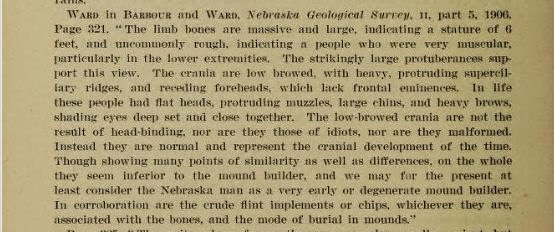
6 Foot Neanderthal Hybrids Uncovered in Nebraska


6 Foot Neanderthal Hybrids Uncovered in Nebraska


 6 Foot Neanderthal Hybrid Uncovered in Nebraska

 Science Magazine,  Nov. 16, 1906 

EVIDENCE OF MAN IN THE LOESS OF NEBRASKA
      After careful investigation, the writer stands ready to announce his belief in the occurrence of human remains in the loess of this state, and for this primitive type, he has proposed the name Nebraska loess man.  Such importance attaches to the discovery as to warrant a paper devoted to the geological facts connected therewith.      Physiographic Features.-North of Omaha for a number of miles the topographic features are bold and abrupt for a prairie country due to the proximity of the Missouri River, the relief being 150 to 200 feet. On all sides landslides are in evidence and must be reckoned with in all fieldwork. Early in October Mr. Robert F. Gilder, of Omaha, opened a mound on Long's hill facing the Missouri River, ten miles north of Omaha or three miles north of Florence, Douglass County, Nebraska. From Florence north to Long's hill there is a continuous section along the roadside for about three miles and from the base of Long's hill to the summit, on which Gilder's mound is situated, there is an unbroken section, hence the geology of the place is well exposed, and being simple is easily interpreted. The public highway, which is about forty feet above the river level, is just upon the top of the Carboniferous, the dark carbonaceous shales of which constitute a distinct geological feature. Upon the shales there rests an average of ten to twenty feet of glacial drift containing occasional Sioux quartzite and granitic boulders. Upon the drift comes 150 feet of bright buff loess such as is conspicuous in and around Omaha and Council Bluffs.


     Long's hill stands 200 feet above the river level, and 150 feet above the valley out of which it rises. It is a hill of erosion, and no discoverable land slip has complicated its simple geology. On its summit is Gilder's mound, in the superficial layer of which were found mound-builder remains, and in the deeper layer eight skulls and many bones of a still more primitive type. The writer at once joined Mr. Gilder in a critical investigation of the place, continuing the work from time to time to December 2, 1906, with results leading to the conclusion that two of the skulls are mound builders', in all probability. These were found in the upper layer readily discernible as a mixture of black soil and light buff subsoil such as would result from digging and burying. This layer has a thickness of two and one-half feet. Below it was an undisturbed layer of unmistakable loess and in it numberless fragments of human bones and an occasional animal bone, loess shells and stray angular pebbles. In brief, the conclusion is that in the case of the upper bone layer there was the burial, in the- lower, deposition. Those in the loess doubtless antedate the hill itself while those in the upper layer are subsequent to it. That archaic burial could have taken place in loess without detection is altogether improbable. Of necessity, there would result in a mixture of black with light soil and a breaking up of the lithologic structure. Where these bones occur the loess structure and color is perfectly preserved and it contains characteristic vertical lime-tubes, concretions and shells precisely as is customary. Out of the evidence at hand, the writer concludes that bones of this layer were strictly synchronous with the loess formation in which they were found, in substantiation of which comes the fragmental nature of all of the bones, their water-worn condition, their range of distribution, and disassociation of parts.      One would scarcely think of such conditions being possible in the case of human burial; besides it is improbable that a primitive people would dig graves to a depth of twelve feet. Should a people without tools and appliances perform such an improbable feat, would they bury water-worn fragments, would they scatter them so widely as not to exceed five or six pieces to the cubic yard? How could they replace the earth in the grave in such order and regularity that there would be perfect structure and gradation of color from soil to subsoil?      Methods of Exploration.-Early in November the writer recognized that the bones in the loess were apparently fossil, and great care was exercised in all subsequent work. On extending the cross trenches which Mr. Gilder had dug, human bones scattered, water-worn, fragmentary and unrelated were found in natural, undisturbed loess at all levels down to six feet. The most interesting single bit found on this occasion was the left half of a frontal bone secured at a depth of four to five feet. Later, at a distance of five feet, the other half was dug up, and the two parts fit together, completing an interesting low-browed frontal. A jaw, which was found in undisturbed loess at a depth of four feet, was that of a youth. The crowns of the teeth were scarcely worn, so old age can not be assigned as the reason for the absence of all teeth save molars Nos. 2 and 3 in the right ramus and No. 2 in the left. Just as the teeth of any water-soaked jaw drop out readily, so it seems to have been with this one. The inference is that they were lost in the process of deposition. A week later work was resumed, the writer being accompanied by Mr. Robert F. Gilder and Dr. George E. Condra, and the attempt was made to be severely critical and careful.      All surface material was carefully removed and three wide shafts were sunk on the northern, eastern, and southern points of the mound. Each shovelful of earth was scrutinized, all bone fragments carefully saved and recorded. In all some twenty bits were found, as follows: a fragment from the base of a skull, fragments of ribs, limb bones, scapula, and sacrum; a clavicle, calcaneum, three complete vertebrae, two metapodes and a phalanx. Some of the bits mentioned were but slivers, other bits were two or three inches long. Some were badly etched by water, others gnawed by rodents. As each fragment was unearthed a block of the matrix was kept and as far as possible each fragment was preserved in position in the block.


  There were but twenty fragments in this lot, for while it is true that the shafts were sunk to a depth of eight feet, and while bone chips were found at all levels, they were widely scattered and few in number. Among the fragments may be mentioned five or six bits of skull, as many bits of rib, the angle of a jaw, metatarsal No. 3, and two phalanges, and with them bits of Anadonta, Succinea avara, and several angular pebbles. When work was resumed a few days later a circle thirty feet in diameter was described concentrically about the mound, which is about eighteen feet in diameter. The northeast quadrant of the circle was divided into sectors of twenty-two and a half degrees and lettered. This quadrant as a whole was excavated to an average depth of six feet its periphery to an average depth of eight to nine feet, and a shaft was sunk to a depth of twelve feet on the north edge.

Sunday, November 15, 2020

Giant Neanderthal Hybrids With Double Rows of Teeth Discovered in Minnesota

 Giant Neanderthal Hybrids With Double Rows of Teeth Discovered in Minnesota


The Aborigines of Minnesota  1906

     Mr. R. M. Van DeVoort gave information concerning the exploration of a mound of this group about the year 1885.  The bones were about 3 ft. from the surface and consisted of six skeletons, each skeleton occupying a space of about 18 inches by 30 inches. The lower jawbone was large, the teeth, so far as found, all double, the brow considerably receding backward, thigh-bone 22 inches long, upper arm-bone 14 inches long. These bones were taken to Chicago by a doctor some five years after they were discovered.  More giants in Minnesota found here 
www.nephilimgiants.net : Early Sioux Indian Mound Builder Giant Uncovered in Minnesota