STONEHENGE
TODAY & YESTERDAY
BY
FRANK STEVENS
Curator of the Salisbury Museum
with Plans and Illustrations by
HEYWOOD SUMNER. F.S.A.
LONDON:
Sampson Low, Marston & Co. Ltd
Price 1s net
1916.
WHAT WAS STONEHENGE?ToC
The Megalithic Stone structures, which exist not only in this country but also throughout the Continent of Europe, are a special feature of that period known as the Neolithic Age. As has already been shown, Stonehenge represents a very late type, erected at a time when the bronze culture had begun to overlap that of polished stone (Neolithic).
These stone structures can be roughly divided into three classes.
1. Single upright stones, or menhirs (Celtic = "high stone"), which may be commemorative of some great event or personage.
2. Dolmens (Celtic = "table stone"), in which a stone slab is set table-wise on three or four uprights.
3. Cromlechs (Celtic = "stone circle"). Circles enclosing barrows or dolmens.
Stonehenge is a highly specialised example of this last class. Round these cromlechs popular myth and superstition have crystallised themselves into tales of the devil and his works (as in the case of Stonehenge), ogres, giants, dwarfs, Sabbath [58]breakers, and infidels, turned to stone. In nearly every case there is some story of the supernatural, which cannot be accidental, but which must have its root in past religious observance. It is a recognised fact that the worship of stones is more widely distributed than any other primitive cult. Its almost universal distribution can be referred to the tendency of the half savage mind to confuse persons and things, and from seeming likeness of the inanimate to the animate, to endue the lifeless object with the virtue and power of the living object. This mental outlook is better understood in practice than in theory. A Melanesian native may come across a large stone, lying upon the top of a number of smaller stones. It suggests to him a sow with her litter of pigs, and he at once makes an offering to it, in the hope that he will secure pigs. In determining the function of Stonehenge, therefore, it will be useful to compare it with similar existing stone circles. The largest of these in this country is Avebury, not many miles distant from Stonehenge. Unluckily, to-day it is so ruined that its former greatness is hardly to be distinguished by the unskilled observer. Formerly comprising some hundreds of unhewn Sarsen stones, barely a score remain in position at the present day. In Avebury, as it was, can be found the early typic model of which Stonehenge is the final product. The use of the circle as [59]a basic form is common to both. In Avebury the Sarsen is a rough unhewn monolith; in Stonehenge it is squared, dressed, and crowned with its lintel. All evidences of a slow evolution from Neolithic to Bronze culture. But whereas the circle alone is used at Avebury, Stonehenge has in addition the horseshoe series of Trilithons and foreign uprights, and in this particular differs from all other Cromlechs in this country. It is the climax of the Megalithic monument, and its use very certainly must have been connected with the religion of the race which set it up. It was, in short, a religious structure, probably used for the observation of the sun, and possibly connected with "nature worship."
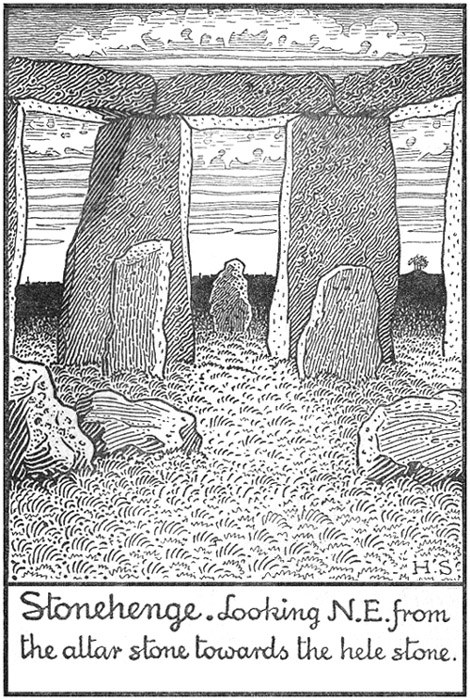
The fact that the sun rises over the Hele Stone on the Summer Solstice, and that it can be observed in direct alignment with the centre of the Great Trilithon, can hardly be due to accident. Chance might bring two stones into such a position on the Solstice, but, in this case, the entire monument is so arranged as to place the rising sun in a due line with its axis on this particular day.
It will be well to consider the facts which must have been within the knowledge of the builders of Stonehenge, and to trace as far as may be their reasoning in the building of it.
To begin with, it is almost certain that at the time of building, there existed some primitive [60]form of priesthood, or body of "wise men." This is quite compatible with the culture of the period. The existence of the Neolithic Long Barrows is sufficient evidence that man had, by this time, arrived at that particular culture which grasps the existence of a "spirit."
Death only terminated the existence of the body, and not that of the spirit. It was even able to return and enter another body, say that of a new-born infant, an animal, or tree. And being after the manner of human beings, spirits could understand human language and become accessible to human petitions. Thus a spirit might even prove a powerful friend or enemy. And the dwellings of these spirits would be those great powers which meant so much to a primitive people; the sun, moon, stars, rivers, forests, and clouds; from which arose the two great classes of spirit, the "ancestral" and the "spirit of nature." From this general body was developed a regular hierarchy of good and evil spirits, gradually ascending to the conception of one great creative spirit, or superior deity.

Stonehenge. Looking N.E. from the altar stone towards the hele stone.
To these early men, therefore, there was always the problem of maintaining diplomatic relations with the unseen forces about them, and for this purpose a primitive priesthood became necessary. The chieftain would manage the temporal affairs of the tribe, those spiritual would be relegated to a special body of wise men, or intermediaries.[61] [62]These men would certainly, from the nature of their calling, be not so much men of action as men of learning, the recorders of history and tradition, students of the natural phenomena, and of all those signs and portents which concerned the good of the community. One of the earliest facts which impressed itself upon them must have been the horizon. It was above that horizon that the sun rose in the morning, and below that horizon that it sank to rest at night; further, when the sun had set the moon and stars peeped up from that line, and sank below it, all in due course. These were facts easily apprehended. The common people even had grasped them, but the wise men learned more. As the link between man and the spirits of the stars, sun, and moon, they came to recognise that the sun did not rise over the same spot on the horizon every day. In the summer it rose roughly in the north-east and set in the north-west. In the winter, on the other hand, it rose in the south-east and set in the south-west. Moreover, these variations would be found to be regular and recurring. The sun would appear to move every day after the Solstice towards the east, and from the east towards the south, back again towards the east, and once more northwards. A staff set in the ground would determine the range of the sun's apparent journey and its extreme limits or turning points. This would fix the Summer [63]Solstice in the north-east, and the winter Solstice in the south-east. Even such simple learning as this was probably beyond the capacity of the tribesman, whose daily duties took him afield early and late. But it was to his interest that all such observations should be entrusted to individuals who could keep definite count, and know exactly at what part of the horizon the sun might be expected to appear. In this way the solar year might be mapped out and divided into Solstices and Equinoxes. Nor was this a mere arbitrary arrangement. The good of the community depended upon it. The agriculturalist depended upon the sun for his crops. It was essential that he should know the correct time to plough, to sow, and to reap. Without the aid of the "wise men" he had no means of knowing what day it was, or how much longer he could count upon the sun for his primitive agriculture. The "wise man," on his side, realised the importance of his knowledge, and doubtless used it to his own advantage, thus winning support and respect from his simple followers. Temples, or stone circles corresponding to temples, might face either to the north-east or south-east, for the Summer or Winter Solstice, marking the end of the sun's journey, or they might be directed towards the east, when the sun would appear in the appointed spot twice in the year; once in his journey southward, and once [64]on his return; in other words, at the two Equinoxes. Stonehenge is so arranged as to mark the sun at its Summer Solstice.
But, interesting as these speculations of the Sun Temple theory may be, the facts recorded by Sir Norman Lockyer in 1901 are even more so, as by independent calculations he has arrived at the same date for Stonehenge as the archæologist. Briefly his task was to calculate the extent of the change in the obliquity of the ecliptic since the building of Stonehenge. The whole process involves a certain knowledge of astronomical operations and calculations, and the reader is referred to Sir Norman Lockyer's book for the actual steps taken to arrive at his conclusion. But on astronomical grounds pure and simple he was able to fix the date of Stonehenge as "lying between 1900-1500 B.C."
It is at all events interesting that his results should tally with those of Mr. Gowland who, working on entirely different lines, came to practically the same conclusion.
Having proceeded thus far it is well, however, not to insist too strongly on the "Sun Temple" theory, on the lines already sketched out. It should be always remembered that the "Hele Stone" is an unworked stone, which stands without the circle, and does not form a symmetrical integer in the structure. Being unwrought it may have been erected at an earlier date, and might belong [65]to an earlier culture. It is possible that Stonehenge may have been a later addition to the Hele Stone. Many of the arguments relating to the "wise men" and the observation of sunrise are matters of analogy rather than direct proof, and though coincidences are ever suggestive and fascinating, they cannot always be entirely accepted as proof. While it is quite possible that the Hele Stone was erected to mark the Solstice and to afford a definite means of determining the year, this may not justify the theory that the entire structure was an astronomical observatory and dedicated entirely to sun worship, with elaborate ramifications, and "observation" mounds for celestial phenomena. Weighing, therefore, the archæologist's and astronomer's evidence, it is fairly safe to conclude that Stonehenge can be dated at about B.C. 1700, and that its use was religious; probably a temple, in which the sun may have been adored in some way. As yet, however, the actual nature of that worship is a matter for speculation. It is of the utmost importance in dealing with a question like this, to observe the greatest caution and to maintain a strictly detached position. The astronomer, archæologist, geologist, and anthropologist have each their share in the solution of the problem, but each also has the bias due to his own special science. The mineralogist solves the problem of the Foreign Stones by suggesting a "glacial drift" [66]without reference to the geologist, who will tell him that the local gravels contain no pebbles which belong to those classes of stones known as Foreign Stones. The astronomer, in his quest for alignments, will convert barrows into observation mounds, without reference to their uses and contents, and without allowing for the ignorance of the period, while the anthropologist often allows his imagination to carry him beyond the limits of actual fact. Time, and constant careful investigation, will pierce some of the mists which must always shroud the origin of Stonehenge, but the true solution will be for the field archæologist, rather than to the weaver of theories or the student in his library.
The circular form, the horseshoe form, the unhewn Hele Stone, all bespeak religious origin. These are actual, visual facts, as is the sunrise on the Solstice. Around these arises a clamour of conflicting claims, each possibly containing much of real importance, each probably expressing some clue to guide the future worker on his way, but none containing that element of finality which is once and for all time to quell the storm of controversy which has ever raged about this ancient monument of the plain.