Showing posts with label mound builders. Show all posts

Thursday, August 29, 2024

Lost Adena Pleiades Mound Cluster in Butler County, Ohio Discovered in a Residential Yard

 Lost Adena Pleiades Mound Cluster in Butler County, Ohio Discovered in a Residential Yard

Burial Mound Photographed in Butler County, Ohio.


The largest mound of this group must have been destroyed at some time, leaving this smaller mound of the group as the only one to survive the urban sprawl. It is situated next to a new home; however, it has been left with thick underbrush and trees growing on it that make it difficult to see.  I photographed 32 large burial mounds in Ohio.  25 of these are `" Address Restricted.  To see photos, historical documentation, and directions to these sites they are found in "The Nephilim Chronicles: A Travel Guide to the Ancient Ruin in the Ohio Valley." Here's a sneak peek of 32 of the largest mounds in Ohio 


The Mound Builders, Archaeology of Butler County, Ohio, 1879:
"On the farms of William Hogan and Charles Borger, section twenty-one, is group of mounds, six in number. A plan of these given in Fig. 56.
  Most people see six, not seven, Pleiades stars in a dark country sky. However, the story about the lost 7th Pleiad appears universal. 
"Mr. L. Demoret looked up the history of and the stories concerning this mound, and writes as follows:
“About the year 1820 this mound was opened by a man named Young, assisted by the Keever brothers, in hopes of finding a treasure chest. They worked only during the hours of darkness, and in perfect silence, in the belief that the chest never could never be reached if a word was spoken while at work. A story was started, and believed by many, that the chest was finally discovered, when one of the diggers exclaimed: ‘I’ve got it at last!’ whereupon it slipped from his fingers and vanished, leaving a smell of brimstone in the air.
“The tunnel was started on the north side, about halfway up the slope, and ran downwards at an angle of thirty-five degrees, for a distance of thirty feet, when the center was reached, from which point it was carried eastwardly several feet. It was stated at the time that the center of the mound gave the appearance of having been once a hut formed of leaning timbers to sustain the great weight of earth. Within this vault were found a stone back-wall, coals and ashes, and human bones."


Monday, August 12, 2024

Are Archaeologist Now Agreeing that the Ancient Adena Mound Builders of the Ohio Valley were Using a Base 60 Babylonian Numbering System?

 Are Archaeologist Now Agreeing that the Ancient Adena Mound Builders of the Ohio Valley were Using a Base 60 Babylonian Numbering System

The earthworks' solstice alignments at Winchester, Indiana, align to make two Pythagorean triangles. Woke archaeologists claim that Native Americans knew these mathematical and geometric principles. I believe the "Hopewell" mound builders were of Dakota Sioux origin. The earlier "Adena" were the Babylonian Amorites. Indian legends say that a white race once inhabited the Ohio Valley and "were skilled in the arts."  The Amorites were called "giants" in the Bible. Plenty of recorded giants are found in Adena mounds. The Amorites are proposed to have built Stonehenge and the conical burial mounds surrounded by a ditch in England. There are Adena mounds in the Ohio Valley surrounded by a ditch. Henges are found throughout the Ohio Valley. Two of the henges in the Ohio Valley are aligned to the May 1 sunrise. Beltane May 1 has its origins with the Canaanite/Amorites!  

Delsy Wilson who is one of the docents at the Serpent Mound made an interesting statement. "Isn’t there a proposed Hopewell base measurement also based on 60?" Yes, it is me who advocates that Babylonia Amorites were in the Ohio Valley." We have two confirmed earthwork sites that used the Pythagorean theorem. The two most frequent measures of sun temples (henges) are 660 and 666 feet with one 555 feet in circumfernce. Many of the square earthworks were 1080 feet per side. Both of these number are Babylonian Gematria numbers. They are also both divisible by 60. We also know that earthworks were constructed by a people that understood trigonometry, pi and sqauring circles. The Babylonian Amorotes (the accounted giants in the Bible) were in the Ohio Valley.

An Australian mathematician cracked the code of a famous 3,700 year old Babylonian clay tablet revealing that they were doing more accurate trigonometry nearly 1,500 years before the Greeks.

In 2017, Australian mathematician Dr. Daniel Mansfield from the University of New South Wales decoded a 3,700-year-old Babylonian clay tablet known as Plimpton 322. The tablet, which was originally discovered in the early 20th century in southern Iraq, contains a series of numbers arranged in four columns and 15 rows. For a long time, the purpose of these numbers remained a mystery.

Dr. Mansfield and his team discovered that Plimpton 322 is a trigonometric table. Unlike Greek trigonometry, which is based on angles and circles, Babylonian trigonometry used ratios of sides of right-angled triangles and a base 60 (sexagesimal) number system. This system, the researchers found, enabled the Babylonians to create a trigonometric table that is more accurate than the Greek method, as it avoids irrational numbers and provides exact ratios.

Key points about this discovery include:

1. Plimpton 322 predates Greek mathematicians such as Hipparchus, who is often credited with founding trigonometry, by more than a millennium.

2. The Babylonians' use of a base 60 number system allowed them to make complex calculations with great precision. Their method is particularly advantageous for some practical applications, such as surveying and architecture.

3. The tablet shows that the Babylonians had a sophisticated understanding of right-angled triangles and could solve problems related to their sides with exceptional accuracy.

4. This finding suggests that the history of mathematics is richer and more complex than previously thought, with advanced mathematical practices emerging in different cultures independently.

The discovery of the true purpose of Plimpton 322 has reshaped our understanding of ancient mathematical knowledge and highlights the advanced capabilities of Babylonian scholars long before similar concepts were documented in Greek mathematics.


Friday, August 2, 2024

The Winchester, Indiana (Randolph County) Adena Giant's Earthwork. Constructed Using the Pythagorean Theorem

 The Winchester, Indiana (Randolph County) Adena Giant's Earthwork. Constructed Using the Pythagorean Theorem

According to Indiana archaeologists the Winchester earthworks were constructed using the Pythagorean theorem.  It is of interest that the earthworks at Newark were spaced also using the Pythagorean theorem. 
  This is a short video that highlights all of the mathematics used in the construction of the Newark Earthworks. The Pythagorean theorem, Pi, and square roots of numbers were all employed in the construction. 
    When Native Americans (Algonquin, Indiana) were asked about the earthworks in the early 1800s, they shrugged and said they were there when they arrived in the area.

    Brad Lepper in a talk about the Newark earthwork admitted that the Pythagorean theorem was used in the layout of the large henge and the circle and octagon. He reasoned that not believing that the Native American knew the theorem was racist. There is no evidence that Native Americans had any kind of advanced mathematics. There legends suggests that a foreign people had come to North America and had built the mounds and earthworks in the Ohio Valley.


Thursday, July 25, 2024

Sun Temple (Henge) in New Castle, Indiana Aligned to the Winter Solstice Sunrise

 Sun Temple (Henge) in New Castle, Indiana Aligned to the Winter Solstice Sunrise


It has been a few years since Archaeology Month was celebrated at the 2,000-year-old sun temple (henge) located in New Castle, Indiana. The henge is aligned to the winter solstice sunrise. The center of the enclosure had a burial mound that would have acted as a marker for the solar alignment. Archaeologists removed the burial mound as part of Archaeology Week. Archaeologists also removed the burial mound in the center of the henge at Mounds State Park completely ignorant to its importance as a solar marker. There are 85 burial mounds and earthworks in Indiana. Only THREE are recognized as historic sites. All of the mounds in Indiana can be found in the book below. A total of 222 burial mounds with histories, current photos and directions to the sites are in the book, unprotected henge is near Muncie, and another in Allen County, Indiana.


                                                              Discover Ancient Indiana


Monday, July 22, 2024

Megalithic Celtic Stone Circle is Uncovered at Point Pleasant, West Virginia


Megalithic Celtic Stone Circle is Uncovered at Point Pleasant, West Virginia


Another piece of evidence that links the Ohio Valley mound builders with the earlier Megalithic Celtic culture of England. A short distance from this site a giant Nephilim skeleton was found within a megalithic chamber in Athens County, Ohio. www.nephilimgiants.net : Skeletons in Megalithic Arched Giant's Stone Tomb in Athens County, Ohio


Bureau of Ethnology, 12th Annual Report


     Below the mouth of the Kanawha the caving in of the bank of the Ohio had exposed a wall of stone, on some of the slabs of which were rude totemic and other marks made be some pecking tool. Careful excavations revealed a circular enclosure about 100 feet diameter, Inside measurements. The wall was composed of angular slabs of various sizes from the hills nearby and averaged 25 feet across the base by 3 1/2 in height. Many of the stones bore evidence of fire, the spaces between them (they were laid flat with joints broken) being Filled with charcoal, ashes, and earth, separate or mixed. No gateway was found, though no doubt one exists at some point not excavated. The sediment from the overflows has accumulated to the depth of about 5 feet since the wall was built, and its existence was never suspected until exposed as above stated by the falling in of the bank. This may not be aboriginal work.


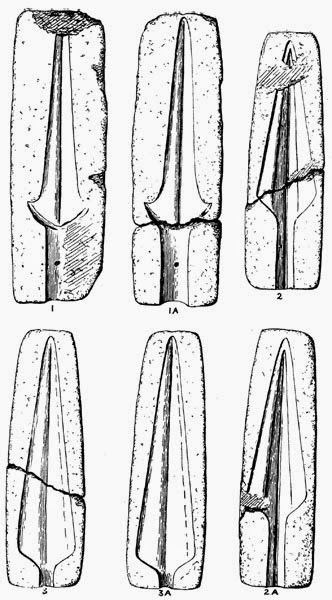
Molds For Copper (Bronze) Weapons Discovered in Wisconsin: Rewriting History


Molds For Copper (Bronze) Weapons Discovered in Wisconsin: Rewriting History


These weapons were identical to Middle Bronze Age weapons used by the giant Amorites who controlled Babylon. More here.  www.nephilimgiants.net : Biblical Amorites Weapons of the Great Lakes Copper Culture


Finds like these molds have been suppressed by archaeologists because it refutes their outdated Berengian Theory.  The lies continue...

Prehistoric America, 1899

     The Mound Builders are supposed to have been quite ignorant of any process of fusing metals, and their weapons, or implements of copperwere, as we have more than once remarked, shaped by hammering. A recent discovery, however, is claimed to modify this opinion and to prove that in one place at least the Mound Builders understood the art of smelting metals. Some recent excavations in Wisconsin have yielded not only implements of copper but the very molds in which they are supposed to have been cast. It is desirable that other facts should confirm an assertion upsetting the hitherto generally received opinion.' It has been held by some and with much probability, that the molds were used in the process of shaping cold copper, a piece of approximately similar form having been put into the mold and hammered until it took the shape of the cavity. The experiment was successfully tried by Dr. Hoy with one of the stone molds.


Get it Here

Indian Legends of Yellow Hair: King of the Ohio Mound Builders


Indian Legends of Yellow Hair: King of the Ohio Mound Builders


Shawnee Indian legend tells of a strange white race that were the mound builders who were led by a great chief they call Yellow Hair


     A tall Chief with yellow hair ruled over them and for ages, they fought off the red men and held the fisheries of the falls and the hunting grounds for their own. The sun was the god they worshiped, and he appeared to have blessed them with peace and plenty. Yellow Hair our people called the Chief, who was a giant. The Chiefs or Kings must have maintained the great stature by intermarrying in the royal family, probably killing all the females except just enough to perpetuate, the race. 
   But our people had long viewed the land from afar and they determined to possess it. The Chief at that time was Hawk Wing, the line through which I come. He sent spies to make overtures to the strange white people and they visited Yellow Hair and told him the Shawnees wanted to share with them the fisheries and the hunting grounds.
    Yellow Hair listened to their statements and then told them that there was just enough for the white people and that he and his people preferred to live by themselves. Then the Ambassadors of the Shawnees said that if the white people would not submit peacefully to having them as neighbors, they would slay them and take their possessions.

Friday, March 22, 2024

Adena Burial Mound Photographed in Dekalb County, Indiana


Adena Burial Mound Photographed in Dekalb County, Indiana


The Platter mound has been further reduced in the last one hundred years by digging. The “rude earthwork,” described above was not found. It is located on a high bluff of the St. Joseph River, but is far enough back that it probably is or was not visible from the river. 

History of  Dekalb County, Indiana, 1885
The Indian mound is on an elevation of ground on Sec. &, on the Adson farm. It’s about ten rods from the “Little St. Joe” and on the south bank of a small creek that empties into the St. Joe at this point. It was opened in the fall of 1837 by Silas A. Bartlett, Daniel Strong Jr., John Platter and Frasier Bartlett. They found a large quantity of human bones about three feet from the surface. The elevation was then ten feet but is now only four. It is evident that this was a sepulcher of the mound builders, and the rude earthworks indicate that here was also at some time a fortification.

                                 85 Burial Mound and Earthwork Sites in Indiana

Friday, January 26, 2024

Linguistics Show Algonquins Were Not the Ohio Valley Mound Builders


Linguistics Show Algonquins Were Not the Ohio Valley Mound Builders


Linguistic shows that the Algonquins arrived late in the Mississippi Valley and could not have been the builders of the mounds in the Ohio Valley. Who the archaeologists call "Hopewell" were the Dakota or Iroquois people.

 Ancient America, 1871.
     Among all these Indians there was a tradition that their ancestors came from a distant region in the Northwest, and this tradition is accepted as true by those who have studied them most carefully. Mr. Morgan supposes they came across the continent and estimates that not less than a thousand years must have passed between the departure of the various groups of the Algonquin family from a common center in the northwest and the condition in which they were found two hundred years ago. When Europeans began to explore North America, this family had become divided into several branches, and each of these branches had a modified form of the common language, which, in turn, had developed several dialects. A long period was required to effect so great a change; but whatever estimate of the time may be accepted, it seems to be a fact that the Algonquins came to the Mississippi Valley long after the Mound-Builders left it, and also later than the Iroquois or Dakota family. That the Iroquois preceded the Algonquins at the East appears to be indicated by the relative position of the two families in this part of the country. Mr. Parkman, in his work on “The Jesuits in North America,” describes it as follows: “Like a great island in the midst of the Algonquins lay the country of tribes speaking the generic tongue of the Iroquois.”


Tuesday, January 23, 2024

Germantown, Ohio's Ancient Mound Builder's Serpentine Earthen Enclosure

 Germantown, Ohio's Ancient Mound Builder's Serpentine Earthen Enclosure


The serpentine gateway at Spruce Hill was duplicated at several hilltop ceremonial centers, including the work at Germantown, Ohio. Another serpent shaped gateway is at Fort Hill in Highland County, Ohio www.nephilimgiants.net : Fort Hill Serpentine Enclosure in Highland County, Ohio

Serpentine gateway of the Germantown hilltop earthwork is very similar to the Spruce Hill gateway. The approaches to this earthwork looked to be man made and undulated like a serpent.

Parts of the original wall that skirts the bluff are still visible in the winter months.

Thursday, January 4, 2024

Iroquois Chief Joseph Brant Claims Ohio Mounds Constructed by an Ancient White Race


 Iroquois Chief Joseph Brant Claims Ohio Mounds Constructed by an Ancient White Race


More legends of an ancient white race that inhabited and built the burial mound sin the Ohio Valley www.nephilimgiants.net : Indian Legends of Yellow Hair: King of the Mound Builders


Life of Joseph Brant -Thayendanega
Includes the Wars of the American Revolution by William L. Stone 1838


Among other things relating to the western country" says Mr. Woodruff, " I was curious to learn in the course of my conversation with Captain Brant, what information he could give respecting the tumuli which are found on and near the margin of the rivers and lakes, from the St. Lawrence to the Mississippi. He stated, in reply, that the subject had long been agitated, but yet remained in some obscurity. "A tradition, he said prevailed among the different nations of Indians throughout that whole extensive range of country, and had been handed down through time immemorial, that in an age long gone by, there came white men from a foreign country, and by consent of the Indians established trading houses and settlements where these tumuli are found".


Tuesday, November 28, 2023

200 Mound Builders Skeletons Uncovered in a Pit in Rural Illinois


200 Mound Builders Skeletons Uncovered in a Pit in Rural Illinois


Another mass grave of giant human skeletons is uncovered in Illinois www.nephilimgiants.net : Large Human Skeletons Mark the Site of an Ancient Battle in Illinois


Reported in the Pantagraph (Bloomington, Ill.)  April 13, 1954, was a discovery of an Indian burial pit in a remote area of Washburn, Ill.  The pit contained over 200 burials. Dr. John McGregor of the University of Illinois claimed they were ancient and were those of the mound builders. Archaeologists did not remove the skeletons that were eventually covered up, where they remain today.


Thursday, October 26, 2023

The End of the Adena - Hopewell and the Eruption of Krakatoa in 535 A.D.


 The End of the Adena - Hopewell and the Eruption of Krakatoa in 535 A.D.


The end of the Adena Hopewell mound building and the construction of the geometric earthworks ends at about the date of 535 A.D. when Krakatoa erupted causing two years of a "nuclear winter." But there is evidence in the Ohio Valley that the Hopewell Sioux resumed mound building in the Mississippian era with the platform mounds at the Marietta and Cedar Banks works in Chillicothe. www.nephilimgiants.net : Your Guide to Ancient Adena Hopewell Earthworks at Marietta, Ohio


The End of the Adena Hopewell
Era
    There is evidence revealed in David Keys, Book called “Catastrophe” that a global disaster occurred in the year 535 A.D. This was caused when the volcanic island of Krakatoa, located near the equator in the Indian Ocean literally exploded. Pyroclastic debris was thrown into the air and because it was close to the equator, the ash spread across the entire globe resulting in what we would call now a “nuclear winter.” Starvation and plague covered the earth; the Adena-Hopewell Empire began to crumble.
    Civilizations fell across the world, Rome and Teotihuacan of Mexico succumbed to famine at the same time. As in Europe the fall of the Adena Hopewell ushered in the Dark Ages in the Ohio Valley.


Saturday, October 7, 2023

Adena Stone Hilltop Enclosure with a Stone Burial Mound: known as Glenford Fort

 Adena Stone Hilltop Enclosure with a Stone Burial Mound: known as Glenford Fort


Glenford Fort was purchased by a non-profit organization. The central stone burial mound was restored. The field is still planted, so going to the mound is trespassing in the planting season along with the fact that the mound is left overgrown in the summer making the mound look like an elevated patch of weeds. Like 90% of ancient mound and earthwork sites it is best to visit in the winter months. In central and southern Ohio, the best dates are from Dec. 1 - April 1.  A good example of visiting in the winter is Fort Hill. Go in the summer and you will have a hard time seeing the stone wall or traversing the area within the enclosure. Go in the winter! www.nephilimgiants.net : Fort Hill Serpentine Enclosure in Highland County, Ohio


Located in Glenford, Perry County. It is a 27-acre Adena culture hilltop enclosure of sandstone boulders, the earthwork was in use between B.C.-500 A.D.

This is what the stone burial mound looked like before restoration. In the winter the once six-foot stone walls that are now one foot can be traced around the perimeter of the hilltop. 


The stone sacred via that leads up to the top of the hill and enclosure is still visible. Was this via natural or cut by the builders of the complex? We were unable to determine. Continuing down this path to the bottom of the hilltop is a rectangular earthwork.